


,_and_his_Kazakh_counterpart,_Akhylbek_Kurishbayev_260826_1787771315.jpg)
Hungary’s 4iG targets wind, SMR investments in CEE, Balkans
1 day ago
Frozen ground is thawing faster each summer almost everywhere it has been measured, according to the first global assessment of long-term monitoring data, and that threatens to set off a CO₂ giga-bomb in the coming decade.
Russia is currently 45% covered by permafrost, most of it in the northeast corner, but once temperatures pass 3°C above the long-term industrial average, all that ice is gone, that will release an estimated 800-1,000 gigatonnes of primordial CO₂ trapped in the ice – twice the amount of CO₂ released by all of humanity since the dawn of history – almost overnight with unpredictable consequences. The disaster in Nepal this week is an early warning of what can happen when the world’s ice melts too quickly.
As IntelliNews reported, Siberian permafrost could disappear by 2100 as rapid thawing accelerates, but more recent measurements suggest the permafrost thaw is accelerating and that deadline could be brought forward by several decades.
Active layer thickness - the surface layer that thaws and refreezes each year above permafrost - increased significantly at 55% of Arctic sites and 38% of Antarctic ones between 2000 and 2024, at more than 90% of European mountain and high-elevation Asian sites, and at sites in South America, according to a study published in Communications Earth & Environment on August 26.
The work draws on field measurements from 156 sites with at least ten years of records, an average record length of 20 years, compiled from a wider pool of 316 observational sites. It was led by Dmitry Streletskiy, professor of geography and international affairs at George Washington University, with 30-odd co-authors running national monitoring networks.
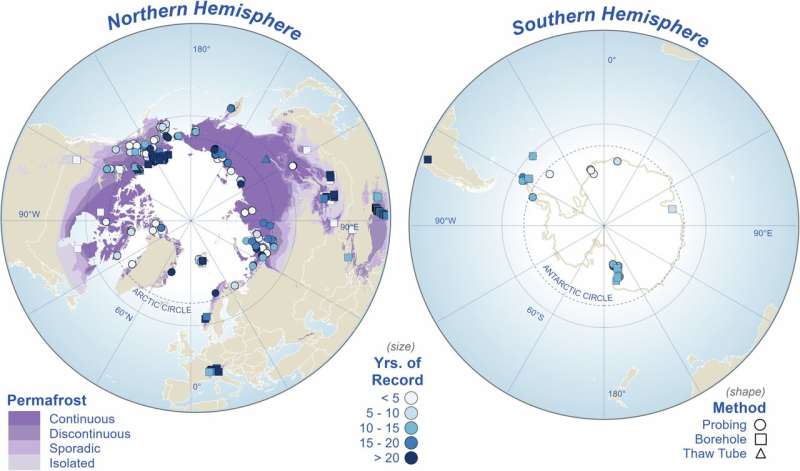
The Circumpolar Active Layer Monitoring networks, north and south. Symbol shape shows the measurement method, colour the length of record. Source: Streletskiy et al, Communications Earth & Environment (2026), via Phys.org.
What makes this different from the modelling that dominates permafrost coverage is that these are holes in the ground, probed by hand or read off boreholes and thaw tubes, in some cases for a quarter of a century. Models have consistently disagreed with observations about how fast degradation is running. This is the observational side finally being assembled globally.
The headline count for the Northern Hemisphere is that 66.4% of sites - 91 of 137 - showed statistically significant increases, 32.1% showed no significant change and just two sites showed a significant decrease.
Mountains melt fastest
Mountains are thawing fastest by a wide margin. European mountain sites averaged an increase of 10.3 cm a year against 0.8 cm a year in the Arctic and 3.2 cm on the Third Pole. Swiss Alpine bedrock sites ranged from 0.9 to 36.2 cm a year, and at Schilthorn the active layer exceeded 1,300 cm in 2022, the highest on record and confirmed across multiple boreholes. Italian Alpine sites gained 9.7-20.2 cm a year and French ones 7.7-17.6 cm.
Russia’s gas industry is threatened by melting permafrost as much of its pipeline network is built on piles driven into the icy ground. If that ground melts, then those pipelines will collapse. The Russian northwest showed an increase of 3.9 cm a year in continuous permafrost, with 0.7-2.5 cm south of Vorkuta. On the Yamal Peninsula, the heart of the country's gas industry, the active layer deepened by 0.4-0.7 cm a year, and by up to 2.1 cm on Bely Island, with the higher readings at sandy sites. Near Urengoy it ran at 2.7 cm a year, at sites where taliks - permanently unfrozen layers between the active layer and the permafrost below - have appeared.
Talik increasingly common
A talik is a layer or body of year-round unfrozen ground found inside or below a permafrost area. They used to form after fires or hydrological disturbance; they are now turning up in undisturbed ground where summer thaw simply outruns winter freeze. Once one forms, the ground above it has stopped being permafrost in any load-bearing sense, which undermines the integrity of every pipeline, pad and railway built on the assumption it would stay frozen. Russian studies estimate that entire cities in the interior will have to be rebuilt if their foundations are sitting on top of what will become mud.
Central and eastern Siberian sites gained 0.4-1.0 cm a year and Igarka 3.0 cm; northeast Siberian sites in the Indigirka and Kolyma basins 0.3-1.0 cm; Chukotka 0.4-0.9 cm and Kamchatka 0.2 cm. In North America the average was 0.4 cm a year in continuous permafrost and 1.0 cm in discontinuous, with Alaskan Interior sites reaching 2.6 cm.
The ground that is protecting itself best is the ground with the most ice and the thickest organic cover. Peat and ice-rich soils change least because melting ice absorbs an order of magnitude more energy than warming soil does. Bedrock, sand and gravel conduct heat and deepen fastest. Sites in discontinuous permafrost generally moved more than those in continuous permafrost.
Regression analysis attributes Arctic changes to rising thawing degree-days first and increased total rainfall second. For every other region they say plainly that more sites and longer series are needed before attribution can be claimed.
The IntelliNews PRO service includes access to reports, exclusive market data, and more news that decision-makers care about. Stay ahead of the market with IntelliNews PRO.
Sign Up Now


