Ukrainians rank corruption above missile strikes as the country's biggest problem - poll
1 day ago
Latvia is facing a demographic "triple squeeze" that will leave it with roughly 1.5mn people by 2050, a fifth fewer than today, according to figures highlighted by economist Holger Zschaepitz on August 8. The country's old-age dependency ratio is projected to rise by around 23 percentage points over the same period, while its pension replacement rate — retirement income as a share of pre-retirement wages — is set to fall by roughly 33 percentage points, one of the steepest drops anywhere in the EU.
Fewer workers, more retirees and thinner pensions relative to wages is a combination that raises the risk of old-age poverty and makes private retirement savings increasingly necessary, rather than optional, for Latvians now in work.
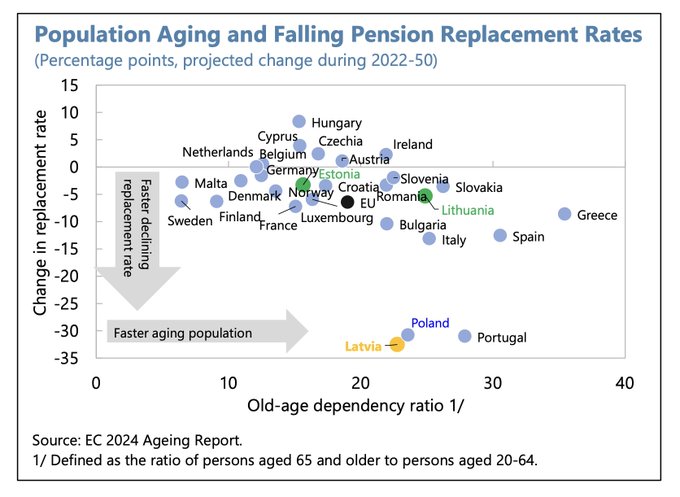
Latvia projected to see one of the EU's steepest combined rises in old-age dependency and falls in pension replacement rates, 2022-50. Source: European Commission 2024 Ageing Report.
Latvia is not an outlier so much as the sharper edge of a regional trend. Lithuania's population is projected to shrink by roughly 20% between 2024 and 2050, from 2.9mn to 2.3mn, driven by a mix of emigration to Western Europe and a birth rate that has fallen to around 22,000 births a year against roughly 40,000 deaths; Lithuania is now ageing faster than any other country in Europe, with projections suggesting children will make up just 11% of the population by 2045-2050 against close to 30% pensioners.
Estonia is comparatively better placed — Eurostat projects it will lose only around 1% of its population by 2030, against roughly 11% for Latvia and 15% for Lithuania — but even Estonia has only one region expected to see positive population growth by 2050.
The EU's population as a whole is expected to start declining from 2029, with the losses concentrated in the Baltic states and the rest of Central and Eastern Europe even as some western economies still grow through immigration. A separate Eurostat-based analysis has found eastern EU countries face mounting demographic strain from shrinking, ageing populations, with the Baltic states and Bulgaria among the worst affected.
The Baltics' squeeze is a regional variant of a global story: three-quarters of the world's countries are now projected to fall below the fertility rate needed to replace their own population by 2050, and the world is running out of mothers of childbearing age fast enough that, in a growing number of countries, the decline is now mathematically difficult to reverse regardless of any fertility policy adopted.
Ukraine, ravaged by war-driven emigration on top of a pre-war low birth rate, has the worst demographics in the world.
Ukraine's own outflow has continued as of the war grinding into its fifth year: departures exceeded returns by 244,300 in the first half of 2026, according to OpenDataBot data cited on social media on August 8, with 7.13mn Ukrainians leaving against 6.89mn returning across more than 14mn border crossings. That is almost unchanged from the roughly 251,000 net outflow in the same period of 2025, suggesting the pattern has become structural rather than a one-off wartime spike.
The IntelliNews PRO service includes access to reports, exclusive market data, and more news that decision-makers care about. Stay ahead of the market with IntelliNews PRO.
Sign Up Now