
Iran's central bank governor said obstacles to banking transactions with Iraq have been removed following a meeting between officials in Baghdad on August 19 and 20, according to Iraqi and Iranian media outlets.
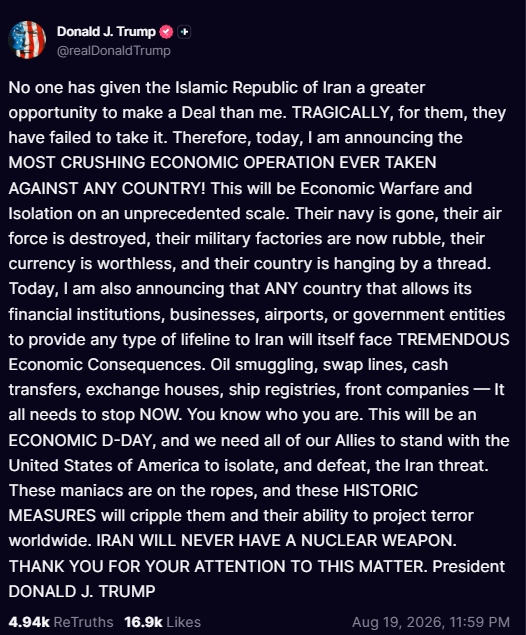
The Iranian statement comes just hours after US President Donald Trump announced what he called the most crushing economic operation ever mounted against a country, warning that any state whose financial institutions, businesses, airports or government bodies provided "any type of lifeline to Iran" would face severe economic consequences, without directly referring to Iraq, which has been stuck between Tehran and Washington in recent months.
In his social media post on Truth Social, the US president named oil smuggling, swap lines, cash transfers, exchange houses, ship registries, and front companies. Iraq is the most exposed of Iran's neighbours, holding an estimated $10bn to $11bn in payments for Iranian gas and electricity that US sanctions have kept in restricted accounts (as shown below), in a direct challenge to Iran's neighbours, including Iraq, Qatar and Oman.
Abdolnasser Hemmati said the "ground had been prepared" to draw on those resources within weeks, following talks with Iraqi officials, and stressed the importance of collecting dues and accelerating economic exchange.
He said the main outcome of his recent visit to Baghdad was Iraqi Prime Minister Ali al-Zaidi's agreement to issue guarantees to Iranian contractors, backed by Iranian assets held in Iraqi banks. Executive orders to that effect have been issued.
Hemmati said the readiness of Iraq's new administration opened scope for wider trade and economic cooperation.
Al-Zaidi, a businessman and banker who took office on May 14 with US approval, leads a government under pressure from Washington to curb Iran-aligned armed groups.
A separate memorandum on releasing Iranian monetary assets remains suspended pending approval from Iran's leadership, Hemmati said, adding that all economic negotiations must rest on national interest and carry that approval, a position held by the government and the Supreme National Security Council.
On monetary constraints, he pointed to falling oil revenues, describing the problem as one shared by neighbours including Qatar and Iraq. The difference, he said, is that Iran cannot reach its own reserves because the US has frozen them.
Hemmati took over at the Central Bank of Iran on December 31 after a record slide in the rial, and on taking office pledged economic stability, and has been in constant communication with his regional counterparts and US officials during the pre.
The US and Iran continue to face off with each other in recent weeks with the war between the two not officially ending but also going cold, according to readouts from both Washington and Tehran. Trump's preference for further squeezing the economic lifelines of Tehran was Washington's previous stance before the war launched with Israel on February 28 this year.
Related Articles
UAE-linked tanker reportedly changes course for Iranian port
A tanker intercepted in the Strait of Hormuz has changed course for Iran’s Bandar Abbas port after initially listing the UAE’s Jebel Ali as its destination, Fars News Agency reported on August ... more
India remains uncertain about LNG supply from Qatar
Petronet is sounding the alarm as QatarEnergy examines its force majeure status on a month-to-month basis. What: India’s biggest gas importer Petronet remains in the dark on when ... more
Iran's Bank Pasargad presses regulator to speed IRR850,830bn capital increase
Iran's Bank Pasargad (TSE: BPAS) is pressing the securities regulator to speed approval of a capital increase to IRR850,830bn from IRR469,483bn, according to a bourse filing. The move points to ... more