The European Space Agency's XMM-Newton space X-ray telescope has confirmed observations by Japan's Aerospace Exploration Agency showing an X-ray source within interstellar object 3I/ATLAS, Komsomolskaya Pravda reported on December 17.
According to the Russian media, Japanese astronomers photographed the alleged comet 3I/ATLAS in the X-ray spectrum from November 26 to 28, whilst European scientists conducted observations on December 3.
Both independent studies produced similar results, finding an X-ray source within the cloud surrounding the object.
Astronomers from both agencies agreed the radiation extends approximately five angular minutes into space, or 400,000 kilometres according to Japanese measurements.
European scientists described the image as showing "a bright red spot that looks like a fiery beacon" against a dark background in the centre.
The Japanese photograph appears more informative, suggesting the X-ray source has an elongated shape.
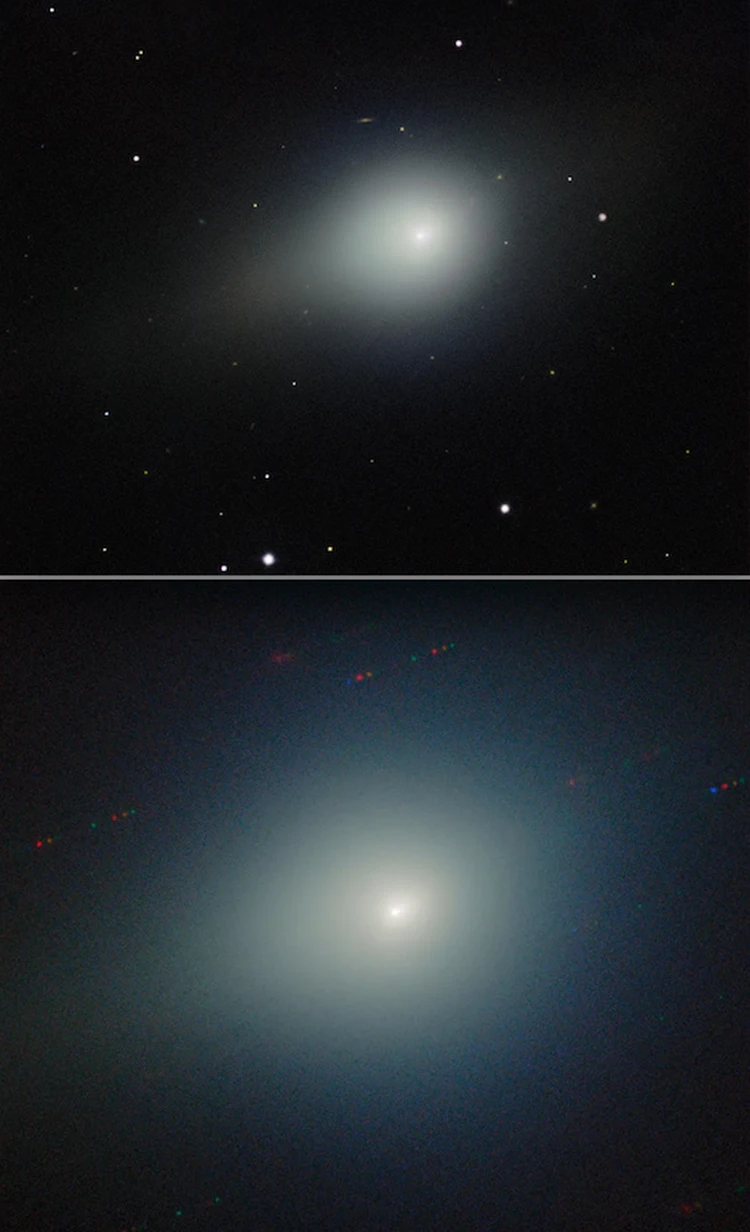
Images of 3I/ATLAS taken using 8.1-metre telescopes in Hawaii with the Gemini Multi-Object Spectrograph also revealed notable changes.
On September 4, the object's emission spectrum was shifted towards red and appeared dim. By November 26, the object had turned green and become much brighter, appearing to increase significantly in size and obscuring all previously visible stars. The anti-tail remains visible in images taken on December 13 from an observatory in Rayong, Thailand.
Russia not convinced
Russian astrophysicist Sergei Zamozdra has dismissed speculation linking the interstellar object 3I/ATLAS is anything other than a passing comet, stating the celestial body follows natural laws of physics, Russian science media reported on December 17.
Zamozdra, associate professor at Chelyabinsk State University's theoretical physics department, said the object's appearance near Earth results from its orbit, whilst its brightness changes stem from interaction with solar wind.
The natural origin of 3I/ATLAS is confirmed by several characteristics, according to the scientist. The object possesses a hyperbolic eccentricity and high velocity, indicating it is not gravitationally bound to the Solar System.
Such characteristics are typical for interstellar objects passing through the system, whilst an artificial object would likely have a more predictable and controlled trajectory.
Observations showed that the celestial body exhibits the typical behaviour of comets and asteroids containing volatile substances that evaporate under solar heating.
An artificial object would likely not exhibit such behaviour, some of the science community says.
Zoya Stepantsova, a member of the International Council of Roerich Organisations, said the Laboratory of Solar Astronomy at the Space Research Institute of the Russian Academy of Sciences noted 3I/ATLAS has generated interest not only in the scientific community but among those inclined to see omens or extraterrestrial spacecraft in celestial phenomena.
"In a couple of months, it will fly further away, and in six months, everyone will forget about it," Zamozdra said.
Earlier in November, Russian scientists from the Space Research Institute had suggested the mysterious non-gravitational acceleration of interstellar object 3I/ATLAS may be linked to solar flares rather than artificial origins, the Laboratory of Solar Astronomy reported on November 2.
The Laboratory of Solar Astronomy said the additional non-gravitational acceleration of 3I/ATLAS may be connected to plasma clouds ejected by the Sun approximately 10 days earlier during the object's approach to perihelion.
According to laboratory data, at least five powerful solar ejections passed along 3I/ATLAS's trajectory from October 23 to 27.


