Europe is drawing up plans for a new Nato without the US and will hold its first military exercises very soon to see how it works in practice.
The transatlantic “special relations” that have provided Europe with a security umbrella since WWII has collapsed. US President Donald Trump has threatened to pull out of Nato completely on at least two occasions in the last year and the member state’s confidence that America will come to Europe’s Article 5 collective security should Russia or anyone else attack is at rock bottom.
Indeed, what goaded the EU into action was Iran firing ICBMs towards Cyprus earlier this month, which were easily shot down, but prompted Nicosia to request clarification on how the EU’s own collective security guarantee, Article 42/7 of the foundation treaty, works in practice.
Nato is not formally dead and relations may revive after Trump leaves office, but Brussels is hedging its bets and it is clear the status quo will not return. With approximately $1.5tn in total Nato defence spending, the US contributes more than $900bn, or about 60%, while roughly 84,000 American troops are stationed in Europe underpinning its security architecture. The danger is if those troops leave then Europe would be left largely naked, which is forcing Europe to reassess cost-sharing, command structures and capital allocation in defence that is currently dominated by the US.
The proposed confusingly nick-named “Euro Nato” would come with higher military spending that is supposed to rise to 5% of GDP by 2035, reindustrialisation of the defence sector, and faster investment in intelligence, nuclear deterrence. Currently Europe’s nuclear stockpile stands at around 5,692 warheads shared between the UK and France.
Euro Nato has nothing to do with Nato other than the two deals have largely overlapping memberships. Nato is an autonomous military alliance with its own executive set up in 1949 under the Washington Treaty. All members of the EU are automatically included in Article 42/7 when they join the Union, following the 2007 Lisbon Treaty. “Euro Nato” would be better named the “EU’s collective security agreement” or EUSCA, but that is not very catchy.
Russia is the enemy, but not only
Since the invasion of Ukraine four years ago Russia is clearly enemy #1, however, more recently since the outbreak of war in the Middle East, as BBC has reported, the CRINK alliance (China, Russia, Iran and North Korea) has been pushed together transforming from Economic Cooperation with the military component towards deeper military joint development.
The so-called “missile shield” in Poland and Romania was set up in XXX to protect the EU from an attack by a “rogue state”. At the time it was sold as protection from a missile attack by North Korea (which no one believed, as it was clearly designed to stop Russian missiles hitting Europe). However, the Iran war has shown that US interceptor defences have been superseded by hypersonic missiles, a technology that both China and Russia now have – and appear to have shared with Iran – that the US and EU have yet to develop, leaving Europe’s eastern flank vulnerable.
And that is before you consider drones. Russia and Ukraine have been in a drone war for three years and while much praise has been heaped on Ukraine’s drone technology, Russia has kept pace in the arms race and is also now a world leader with Ukraine in both development and production capacity. Coupled with China’s BeiDou satellite navigation system, even the state-of-the-art Iranian drones have been able to penetrate Israel’s Iron Dome defences and wrack considerable damage that they were incapable of a year ago during the 12-day war last summer.
On paper, the EU looks to have the advantage. It has 3.5mn men in its collective standing armies against Russia’s 1.3mn; 22,000 aircraft vs Russia’s 4,292; and 1,143 naval vessels vs Russia’s 400. However, in practice, all of Russia’s soldiers are now veterans and its equipment modernised and battle tested.
By contrast, Europe’s logistics are in a shambles without US leadership which currently controls all Nato military on the Continent, its production capacity is massively underinvested and its stockpiles of artillery ammo and missiles badly depleted by four years of supporting Ukraine. The Polish drone incursion last September shows that the EU would be largely defenceless against a drone attack and virtually all the capitals in Europe are open to strikes by Russia’s ICBM Oreshnik and other ballistic missiles.
European Commission President Ursula von der Leyen launched the €800bn ReArm programme last March and €150bn has already been distributed under the SAFE (Security Action for Europe) defence loans last year, but the effort to modernize Europe’s defence sector is still right at the start. For example, since the US withdrew from supporting Ukraine militarily following Trump’s inauguration, the EU has been unable to offset the fall in US military support and arms deliveries to Ukraine have fallen in the last year.
Some European countries have already been preparing for a possible Russian attack. Finland has already fought and lost in war against Russia during the Winter War with the USSR in 1939-1940 during WWII. Since then it has kept its military battle-ready and has one of the strongest armies in Europe. Poland is the only major Nato member that is already spending near 5% of GDP on defence as part of a programme to build up the largest conventional army in Europe.
Article 42/7
Almost all of the EU members are members of Nato and so covered by the Article 5 collective security clause, but the EU founding treaty contains its own collective security clause, Article 42/7, that is very similar to the famous Nato clause.
NATO Article 5 (1949 Washington Treaty): An armed attack against one or more members in Europe or North America shall be considered an attack against all. Each member will take "such action as it deems necessary, including the use of armed force" to restore security.
EU Article 42/7 (2007 Lisbon Treaty, in force 2009): If an EU member state is "the victim of armed aggression on its territory, the other Member States shall have towards it an obligation of aid and assistance by all the means in their power."
Note that in both cases the other members are not automatically obliged to go to war with the attacker, and that there is a period of “consultations” in both agreements where they can choose alternative actions like sanctions. The wording of the EU version for “all means in their power” is considered to be stronger than Nato’s “deemed necessary.”
The problem today is that if Russia were to attack, say, Estonia, few believe the US would choose to go to war with Russia for the sake of a tiny country like Estonia of only 1.5mn people and choose the “such action as it deems necessary” option instead. In Europe’s case some members such as Austria and Ireland are excluded from military service from the start due to their “neutral status.”
One of the fears in some countries in the east is that a discussion on beefing up Article 42/7 may give the US the wrong impression and give them the excuse to further reduce their interest in Nato.
Both regimes remain largely untested. Nato’s Article 5 has only been invoked once, on the occasion of the 9/11 terrorist attacks on New York. France invoked the only use of Article 42.7 in November 2015 following a series of deadly ISIS terror attacks in Paris.
Euro Nato exercises
Having been ignored for almost two decades, suddenly Brussels is moving to activate Article 42/7 and make it a real military commitment.
The EU will hold its first large-scale exercise to test its mutual assistance capabilities in the event of armed aggression against a member state. The exercise comes after Cyprus was targeted by drones launched from Lebanon in March.
Trump's claims on Greenland have also brought the clause to the fore as the EU found itself in the bizarre position of contemplating military action against a fellow Nato member. European Defence Commissioner Andrius Kubilius said in January that the mutual assistance clause would apply in the case of Greenland and also called for the EU to beef up the article with a view to making it fully operational with a clear military command structure as currently Article 42/7 is literally a paper tiger.
The “exercise” is not going to involve troops, but scenarios will be gamed out in the EU's Political and Security Committee (PSC), which is composed of senior EU diplomats. It’s not the first time that the PSC will discuss how to make the security deal operational, but this is the first time they will test scenarios like the case of two countries calling at the same time for the activation of this clause. However, Politico reports that a scenario dealing with a Russian missile hitting a European capital will not be considered. For the meantime, that possibility is being left to Nato to handle.
The games will be overseen by the EU chief foreign policy commissioner Kaja Kallas in what she called a "tabletop" exercise in May to get an idea of how the clause could work in practice. The plan is to test the bloc's political commitment to mutual defence rather than its military response.
According to a senior EU official, the exercise will simulate the decision-making process if a member state turns to the rest of the EU for military support, Politico reports.
The simulation will take place first at the level of ambassadors in Brussels, and then during a meeting of defence ministers in Cyprus in May.
Kremlin push back
Even the war games on paper versions of Euro Nato’s exercises have upset the Kremlin. Previously, the Kremlin has had no problem with Ukraine joining the EU, which it considered to be “just good business.” But the EU proposal to transform itself from just a trade club into a military block is unsettling the Kremlin which is increasingly unhappy with the idea of Ukraine acceding to the club.
Russia responded with a stiff warning to a Four Nato Members meeting on April 17 between France, the UK, Germany and Italy, that is part of the same process and has inflamed already growing tensions.
Over the last few weeks Ukraine has been flying almost continuous drone attacks on Russia’s Baltic Sea oil terminals at Primorsk and Ust-Luga, but has been flying its drones up to the northern ports over the territory of the Baltic states, Nato members, on the presumption that Russia would not dare fire missiles into Nato air space.
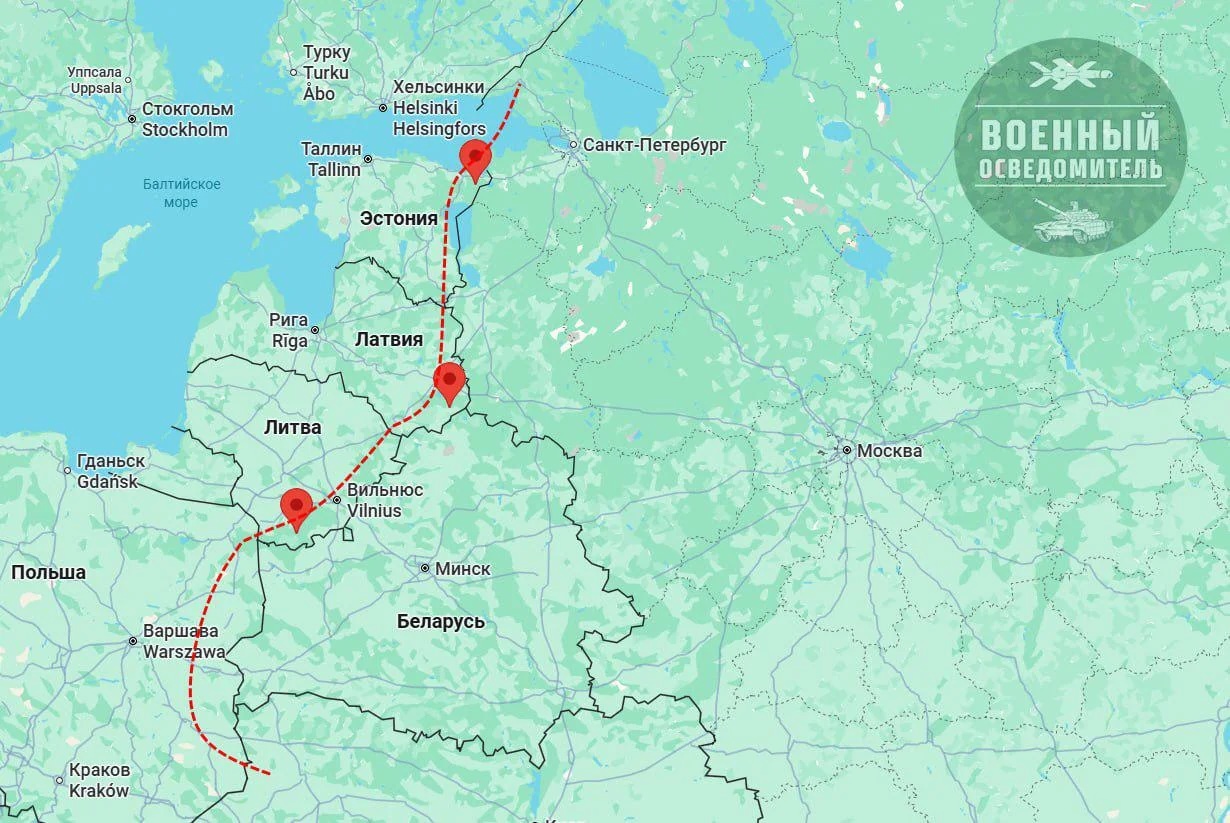
The Secretary of the Russian Security Council Sergei Shoigu said on April 19: “Recently, attacks by Ukrainian drones on Russia have intensified via the territories of Finland, Lithuania, Latvia, and Estonia. If these countries deliberately allow Ukraine to use their airspace, Moscow, according to Article 51 of the United Nations Charter, has the right to self-defence in response to an "armed attack”."
Russia’s ambassador to the UN Vassily Nebenzia has been even more outspoken, accusing the EU of building a "New Reich" from the floor of the UN Security Council last week. Nebenzia accused the EU of preparing for a major war against Moscow and mocked Kallas for forgetting who actually defeated Hitler.
The diplomatic world has not seen language like this in decades. Given that Russia was prepared to invade Ukraine to prevent it from ever joining Nato, if the prospect of Ukraine joining a militarised EU become a reality, then relations will only deteriorate further.