
_Cropped_1786430662.jpg)


Mongolia rations gasoline as fuel shortages send drivers into long lines
10 hours ago
Beneath the Central and Southeast Europe region lies one of Europe’s most underexploited energy resources. Geothermal energy, long associated with Iceland’s volcanic landscapes, is attracting fresh attention as countries seek cleaner, more secure and less import-dependent sources of energy. The appeal is especially strong in a region where the 2022 gas crisis exposed the strategic vulnerability created by dependence on imported fossil fuels.
Unlike solar or wind, geothermal offers something energy planners prize: continuous, weather-independent baseload energy. But in Central Europe, geothermal’s most important role may not be electricity generation, but heating.
The region possesses two advantages. The first is geological; much of Central and Southeast Europe lies above the Pannonian Basin, a geothermally promising sedimentary basin stretching across countries including Croatia, Hungary, Romania and Serbia. The second relates to existing infrastructure as many cities retain large district heating networks built during the socialist era, creating ready-made systems into which geothermal heat can be fed.
“There’s a lot of potential because there’s been so little geothermal put in place so far. At Innargi we are going from zero, to expecting 400MW of capacity by the end of 2030,” says Philip Michael Gosney, chief commercial officer at Innargi, a Denmark-based international geothermal company active in Poland. “I would expect strong incremental growth as markets mature, and people become more confident in the technology.”
Geothermal remains one of the most complex renewable energy technologies to deploy. Unlike solar or wind projects, whose resource can be measured relatively accurately before construction, geothermal developers must spend heavily on drilling before knowing whether the underground reservoir will perform as expected. That geological uncertainty explains why, despite vast theoretical potential, the sector remains underdeveloped across much of the region.
Central Europe’s new energy map
Both the promise and the limitations of geothermal are perhaps best understood by looking at the projects now reshaping Central Europe’s energy map.
In Szeged, geothermal is already part of large-scale urban infrastructure. The Hungarian city has transformed much of its district heating system to run on geothermal energy, reducing gas use while cutting emissions.
Szeged vice mayor Sándor Nagy says the significance extends beyond climate implications. “Obtaining the heat source from beneath our feet instead of importing it from far away lands is a sure way of increasing security of supply, decreasing emissions and generally cutting costs,” he says.
Szeged’s geothermal overhaul was financed through a combination of EU structural funding and private investment. According to Nagy, neither the municipality nor the district heating company could have financed the transition alone.
“EU sources for green transitions are widely available and private investment into a public service in monopoly position is a rather safe bet for a steady return,” he says.
The city’s experience offers an example for the region. Large geothermal systems are capital intensive to build, but operating costs are highly predictable once infrastructure is in place because there is no fuel to purchase. Nagy says the system can operate without municipal subsidy, though Hungary’s regulated residential heating tariffs create market distortions.
“Once built the infrastructure requires no municipal subsidies at all,” he says. “It’s financially viable from end-user payments.”
Szeged is often portrayed as a special case, but Nagy cautions against overstating its uniqueness. “Europe boasts close to 300 large-scale geothermal district heating plants similar to ours, so the word ‘anomaly’ is probably an exaggeration.”
Real potential
Still, geothermal success depends heavily on local conditions. “There is no off-the-shelf solution but I believe that the potential to switch a fossil fuel based heating system to some form of renewable is very much real for most municipalities across Europe,” Nagy says. He adds: “A detailed look at a location’s geological features, energy market, national regulations, existing infrastructure is certainly needed.”
The most immediate opportunity lies in heating rather than electricity generation. In practical terms, this comes down to temperature. Producing heat requires much lower underground temperatures than generating electricity. As Gosney points out: “The benefit of using geothermal for heat is you don’t need the subsurface to be that hot. We don’t heat houses to 200 degrees.”
Because of this, heating projects are scaling faster than geothermal power generation across Central Europe. Innargi is developing two large public heating projects in Łódź and Poznań with utility partner Veolia. Once completed, the projects could supply up to 15% and 20% respectively of each city’s district heating demand.
The decision to introduce geothermal heating in those two cities was based on a combination of geography and demand.
“Poland has a large area in the Polish trough which is good for geothermal heating,” says Gosney. “The subsurface temperatures are pretty good if you want to use it for heat.”
But geology alone is not enough. Heat must be consumed close to where it is produced. “We’re always looking for where you match the most subsurface potential to the most district heating,” he says. “For our business we need the two to geographically match so there’s a customer to off-take the heat when it’s produced.”
The administrations of both cities, according to Gosney, are "very open to new technologies". In addition, he says, "You need a city that has a heat mix where something is going out, so that something new can come in. Veolia is doing a big decarbonisation drive away from coal, and they need to find a technology that can replace it, which is affordable for consumers and preferably green as well."
That existing demand infrastructure gives Central and Eastern Europe a major advantage over countries such as the UK, where district heating is far less developed. “In the UK there might be the subsurface there, but if there’s no one to take the heat there’s no customer for it,” according to Gosney.
Investors eye Romania
Romania offers another example of geothermal’s expanding commercial relevance. Historically, geothermal in Romania was associated primarily with thermal spas and balneological tourism. Today, developers increasingly view it as industrial infrastructure.
Green Tech International controls one of Europe’s largest geothermal portfolios, with 83 deep wells and around 300 MW of installed thermal capacity. Its operations are centred in Romania’s Călimănești-Căciulata area of Romania, where it supplies geothermal energy to local businesses, tourism facilities and heating systems.
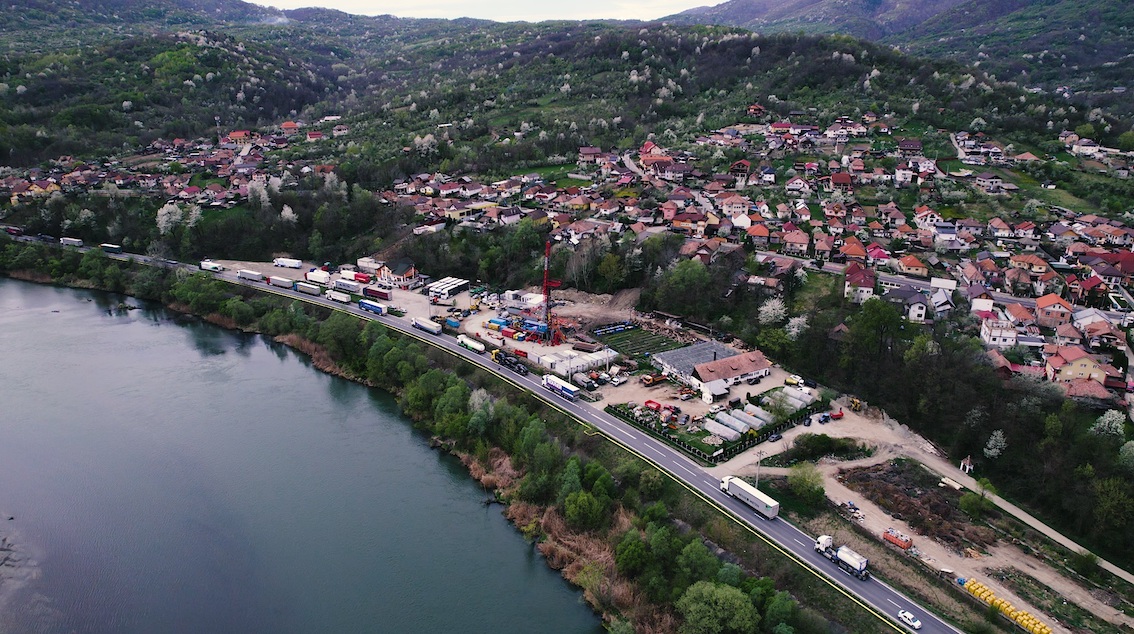
Călimănești, Romania, where Green Tech's operations are centered. Source: Green Tech.
“Our strategy is not simply to sell geothermal energy,” says Dragoș Gavriluță, chief operating officer of Green Tech. “Instead, we focus on sectors where heating or cooling represents a significant operating cost and where access to reliable, low-cost thermal energy creates a sustainable competitive advantage.”
That strategy targets sectors ranging from district heating and greenhouse agriculture to a newer opportunity: AI-era data centres, where cooling costs are becoming increasingly important.
Green Tech’s planned geothermal district heating project in Bucharest illustrates the scale developers now envision. The project, valued at around €200mn, could generate more than 595,000 MWh of clean thermal energy annually while cutting carbon emissions by roughly 127,000 tonnes per year.
“Romania has some of the strongest geothermal resources in Europe and is generally considered to be among the top five EU countries in terms of geothermal potential,” says Gavriluță. “Yet utilisation remains relatively limited.”
Electric frontier
If heating is geothermal’s near-term growth story, electricity generation remains its more ambitious frontier.
That is evident in Croatia, where developers are attempting to build commercial geothermal power plants.
ENNA Geo is developing two projects — Zagocha near Slatina and Babina Greda — that could help establish Croatia’s geothermal power sector.
According to ENNA Geo director Ivana Meašić, Croatia’s resource base is substantial. “Estimates indicate a total potential capacity of 1,000 MW for geothermal power plants. This represents a generation potential approximately three times greater than Croatia’s share in the Krško nuclear power plant, which covers 16 per cent of electricity consumption in Croatia,” she says. “ Therefore, the potential is enormous, although we are still far from achieving it, as Croatia currently does not have a single geothermal power plant producing electricity.”

ENNA Geo director Ivana Meašić. Source: ENNA Geo.
The Zagocha project offers evidence of that promise. Drilling has reached 4,582 metres, making it the deepest geothermal well in Croatia. Tests confirmed geothermal water at 212°C — hot enough for electricity generation.
Once operational, the plant could generate more than 130,000 MWh annually, enough to power over 42,000 households.
But Croatia also illustrates geothermal’s core challenge: risk. “Geothermal projects always involve both geological risk and technical risk associated with well construction,” says Meašić.
“The cost of a single well averages between €10mn and €15mn,” she adds, while a power plant usually requires at least four wells.
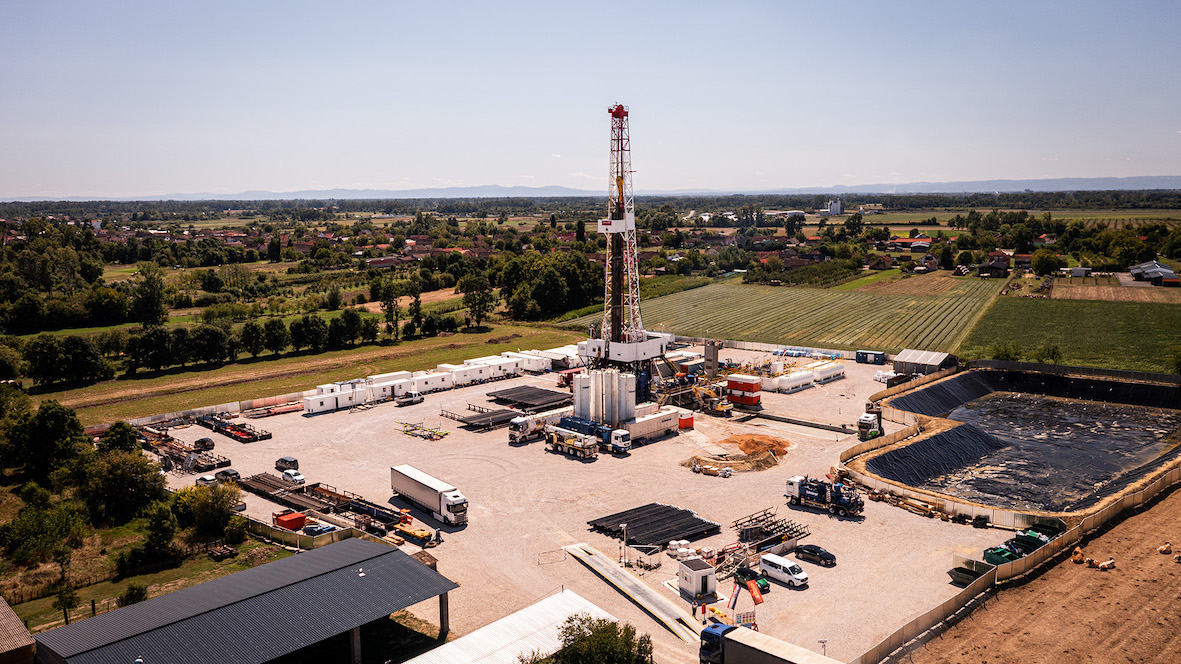
ENNA Geo's Babina Greda project. Source: ENNA Geo.
Risks and rewards
Because exploration risk is so high, bank financing is often unavailable in the early stages. “One of the specific challenges of geothermal energy is that, due to geological risks, it is impossible to attract bank financing during the exploration phase.”
This financing problem helps explain why geothermal electricity has developed far more slowly than other renewables.
Slovenia already uses geothermal energy, but overwhelmingly for heat. According to Mojca Božič, project manager at Dravske elektrarne Maribor, d. o. o., total geothermal energy utilisation in Slovenia reached 2,275 TJ in 2024, with shallow geothermal heat pumps accounting for roughly 74 per cent. Deep geothermal use remains modest, and electricity generation is still experimental.
A pilot power plant installed by the company at the abandoned Pg-8 gas well near Lendava tested an innovative closed-loop geothermal gravity heat pipe system using ammonia as a working fluid.
“The concept of a closed-loop system based on a geothermal gravity heat pipe is technically functional,” Božič says. However, the reservoir itself disappointed. “The available thermal power of the well is lower than expected and does not allow stable continuous operation.”
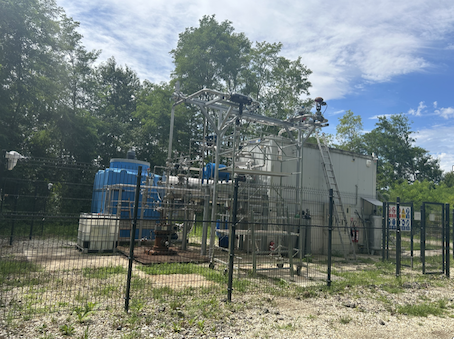
The pilot geothermal power plant in Lendava in Slovenia. Source: DEM.
That distinction captures geothermal’s peculiar difficulty: the surface engineering may work perfectly while the underground resource still fails commercially.
Lithuania offers perhaps the clearest cautionary tale. According to Artūras Razbadauskas, rector of Klaipeda University and a representative of the Lithuanian Geothermal Association, western Lithuania possesses “the highest geothermal potential in the entire east European platform.” He estimates deep geothermal potential for heating and power at more than 20 GW. Yet the country’s geothermal contribution to its energy balance remains negligible.
“Theoretical capacity is immense,” Razbadauskas says, “but past operational failures and a lack of political and business backing have kept this resource almost entirely untapped.”
Built in 2000, the Klaipėda geothermal demonstration plant proved the underlying resource existed. But operations were plagued by reinjection problems, mineral scaling and poor economics. When biomass and waste-based alternatives became cheaper, the project could no longer remain viable.
This raises the central question facing geothermal in Central Europe: if the resource is so promising, why has deployment been so slow? Part of the answer lies in capital intensity. Another concerns policy.
Meašić argues that subsidy frameworks remain essential, especially for geothermal electricity projects. Countries such as Germany and Italy provide long-term support mechanisms that reduce investor risk.
Without such frameworks, even promising projects can stall. “Today, it is particularly important to have access to a clean and reliable source of energy,” she says. “There is no need to import fuel, as geothermal water lies beneath our feet.”
On top of this, she says, “What should also be emphasised is that geothermal energy is a European “product”. The first geothermal power plant was built in Italy and, interestingly, it is still operating after more than 100 years. … Today, more than ever, we recognise that clean, secure and import-independent energy is essential to Europe’s economic resilience and security.”
The technology will not replace all other renewables. Nor will every city prove geologically suitable. Geothermal is expensive, slow to develop and highly site-specific. However, it offers something rare in the energy transition: constant, local, low-carbon heat. For a region trying to reduce emissions while strengthening energy sovereignty, that combination is increasingly attractive.
The IntelliNews PRO service includes access to reports, exclusive market data, and more news that decision-makers care about. Stay ahead of the market with IntelliNews PRO.
Sign Up Now


