

_1784053368.jpg)

Russia's inflation shock complicates rate cut hopes as central bank braces for slowdown
7 hours ago
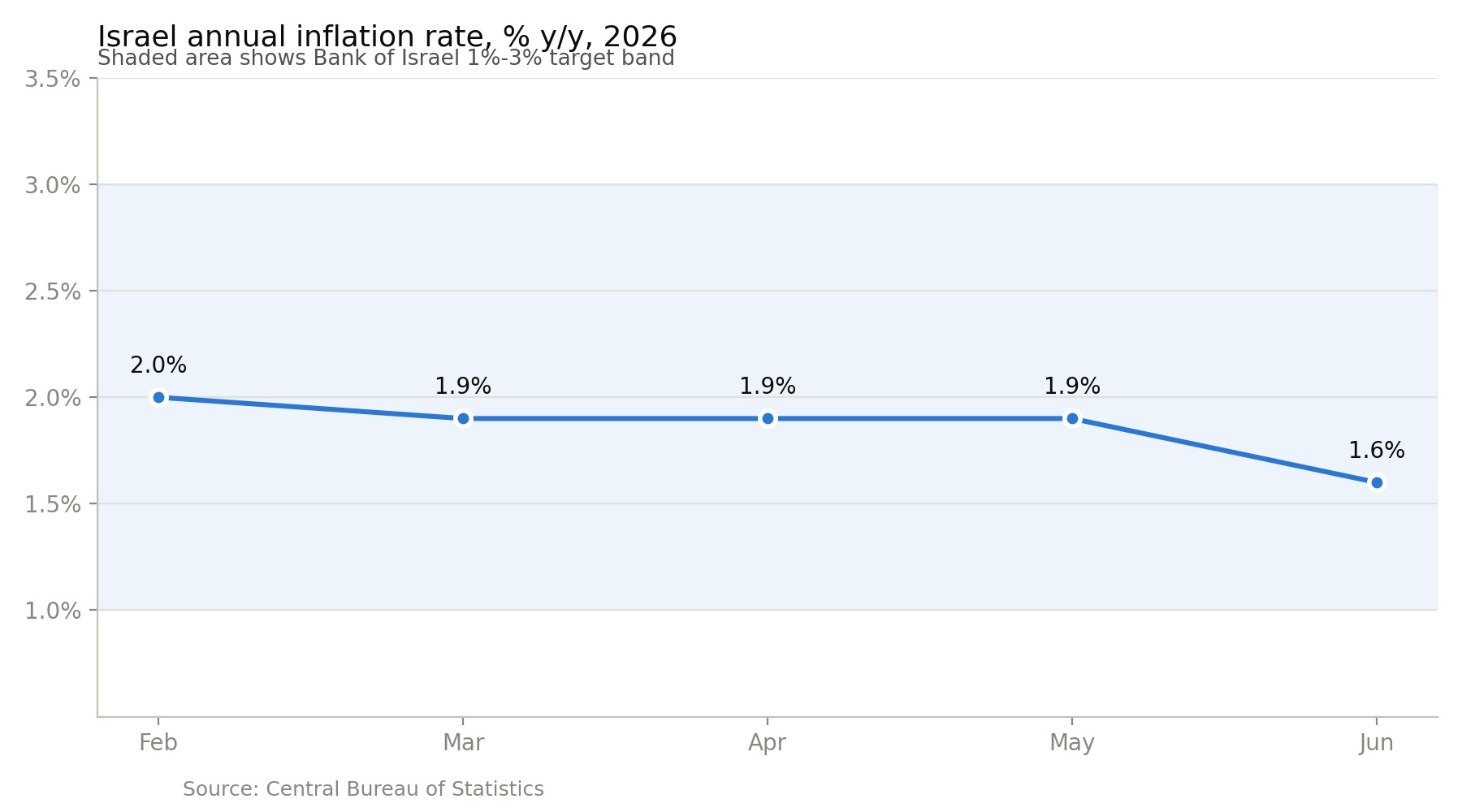
Israel's CPI remained unchanged for June, while the annual inflation rate fell to 1.6% in the 12 months ending June 2026, Central Bureau of Statistics data showed. This is Israel’s lowest annual inflation rate in five years.
Inflation is down from 1.9% y/y in May, while monthly CPI came in flat. According to forecasts from banks and investment houses, CPI was expected to decline by 0.1% to 0.2%. Still, the actual figure sits comfortably within the Bank of Israel's 1%–3% annual inflation target band.
The reading gives the Bank of Israel room to cut, having held rates high through a period of war-driven fiscal expansion and shekel volatility. It also lands alongside a housing market now in outright decline, with home prices down 2% y/y, suggesting domestic demand is weakening rather than prices merely normalising.
June's price movements were broadly deflationary. Fresh fruit and vegetables fell 5.2% m/m, fuel dropped 3.1%, clothing and footwear declined 2.7%, overseas vacations fell 1.6%, and household furniture and equipment eased 0.5%. Transport dipped 0.7%.
Partially offsetting these declines were rises in culture and entertainment, up 1%, housing maintenance, up 0.7%, healthcare, up 0.6%, and food, up 0.4%.
Home prices, published separately from the general CPI, fell 1% between April and May after a 0.3% rise the previous month. Tel Aviv recorded the sharpest contraction at 2.3%, while Jerusalem fell by 1.8% and Haifa fell by 0.5%.
The northern region declined 0.3%, while the central and southern regions were flat. On an annual basis, comparing April–May 2026 with the same period in 2025, home prices are down 2%, underscoring the sustained cooling of Israel's residential property market amid elevated interest rates and ongoing conflict-related uncertainty.


_0_1784176486.png)
