


China's electric cars are displacing more oil than the war has taken off the market
4 hours ago
The danger of runaway temperature rises to create a “Hothouse Earth” is rising at an alarming rate – a state in which humanity cannot survive. A widely shared analysis says the planet is now warming at 0.48°C a decade - almost three times the rate measured from 1970 to 2010 – that will trigger tipping points and fuel positive feedback loops that could turn global warming into a collapse of the ecosphere.
The idea of a Hothouse Earth was first floated in 2018 by the late Australian climatologist Will Steffen and colleagues, who did not expect it before 2100.
But the deadline is creeping forward. This year has already been the hottest summer on record and a super El Niño is building that is already off the charts – literally. Climatologist are complaining the ocean heat anomalies this year are so large that they have had to extent their y-axes upwards to accommodate the latest measurements.
Julian Cribb, an Australian science writer, said in his newsletter Surviving the 21st Century on August 3 that satellite measurements, adjusted to exclude El Niño anomalies, show steady heating of 0.48°C per decade since 2015 - against 0.18°C per decade from 1970 to 2010 and 0.27°C over 2015-25 - and that this would deliver about +3°C of average global heating by 2050, or +4°C once El Niños are added on top.
At that level, he argues, the Paris accord's 1.5°C target and every national pledge made under it are obsolete, the global food system breaks and up to half the Earth's population dies.
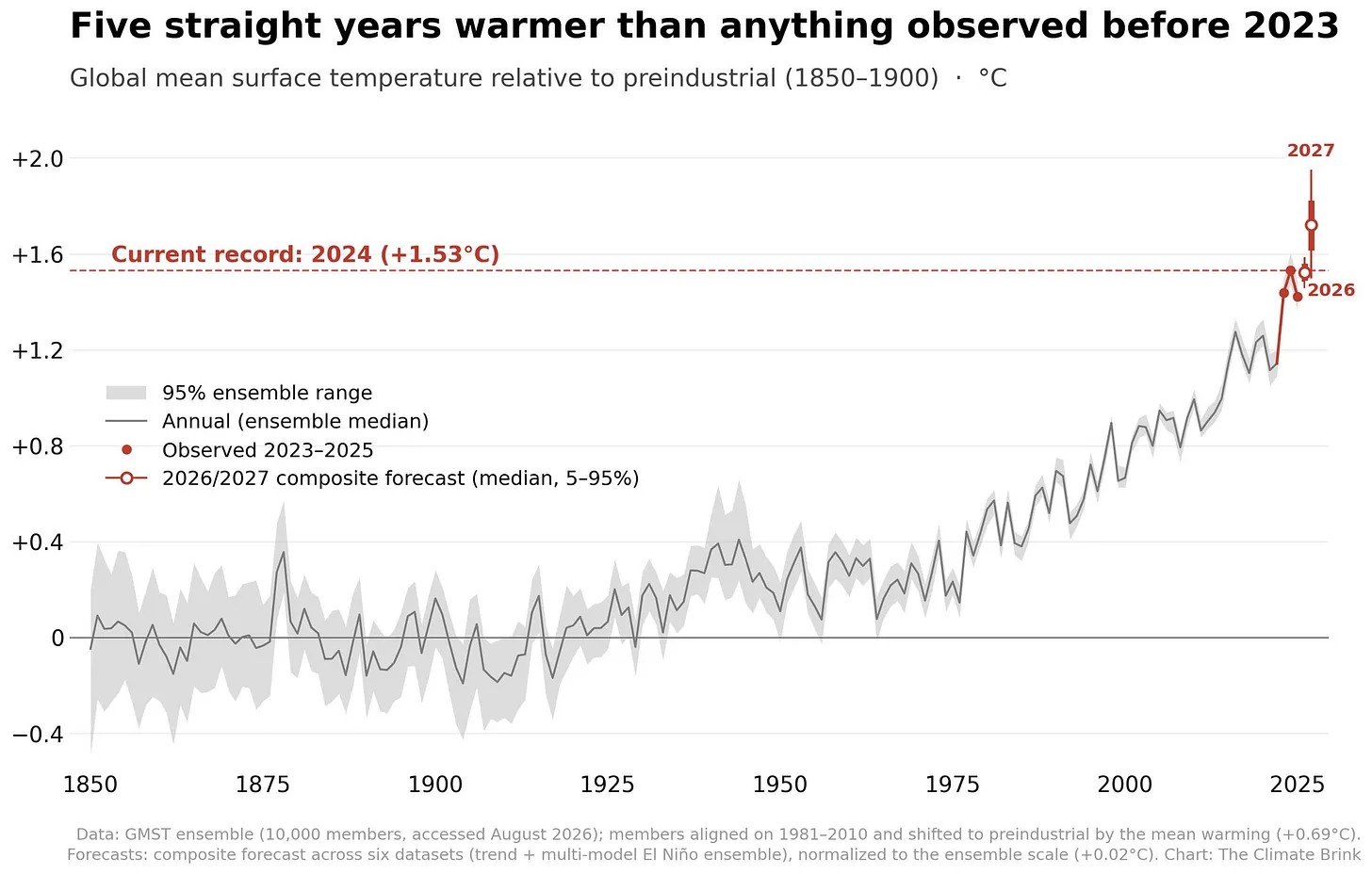
Global mean surface temperature relative to preindustrial (1850-1900). Source: The Climate Brink, GMST ensemble accessed August 2026, via the clip in the REPORTS folder.
The observed record shows 2024 as the warmest year at +1.53°C above preindustrial, five straight years warmer than anything seen before 2023, and a composite forecast putting 2026 slightly below that record and 2027 somewhat above it, with a wide range.
That is a serious picture. It is not 0.48°C a decade compounding to +3°C by 2050, and the gap between the two is not a detail - it is the difference between a crisis that policy can still shape and one that has already been decided.
The mechanism Cribb points to for the near term is real and separately evidenced: a super El Niño building in the Pacific, which will give the world a foretaste in 2026/27. El Niño years run hot, and the forecast on the chart reflects exactly that.
The disagreement is about whether the underlying trend beneath those spikes has fundamentally steepened, or whether a decade that began with a record El Niño is being read as a trend.
Which is the honest state of it. The warming is faster than the Paris framework assumed, the 1.5°C target is in practical terms gone, and the food-system and economic consequences are the right things to be reporting. The 0.48°C -per-decade figure is a stronger claim than the published record supports, and it does not need to be true for the argument underneath it to still pose serious threats to the biosphere and the eventual escalating death toll due to rising temperatures.
The IntelliNews PRO service includes access to reports, exclusive market data, and more news that decision-makers care about. Stay ahead of the market with IntelliNews PRO.
Sign Up Now


_Cropped_1786890919.jpg)
