


Nigeria's cities now hold half the population, up from one in ten in 1950
1 hour ago
Ukraine is on track to record fewer births this year than Kyrgyzstan for the first time - a reversal from the end of the Soviet Union, when Ukraine's newborns outnumbered Kyrgyzstan's five to one, French demographic commentator Clement Molin in a post on social media on August 1.
Ukraine’s demographic collapse has been accelerating and it now has the worst demographics in the world with three deaths to every one live birth. But the whole world is suffering from a widening Demographic Crisis that is affecting everyone.
Ukraine's wartime exodus of millions of young women, combined with a collapsing birth rate and elevated mortality, has left the country facing what demographers call one of the most severe peacetime-equivalent population declines anywhere in the world. But Molin's reports that Ukraine is the extreme end of Eastern EU mounting demographic strain as populations shrink and age across the region, according to Eurostat.
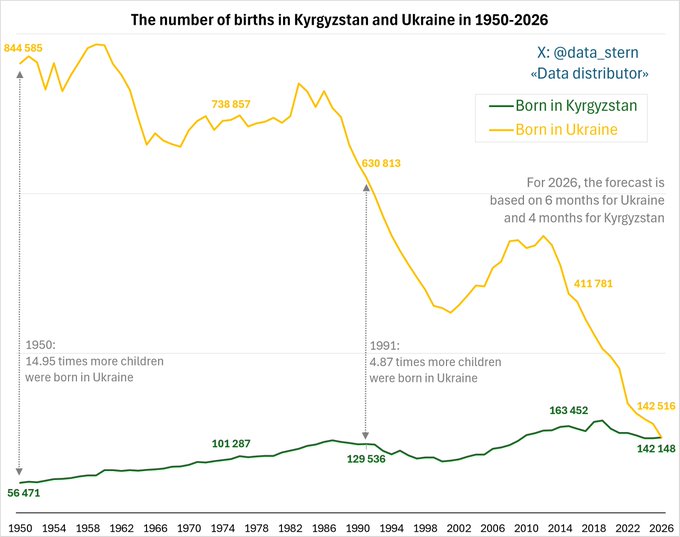
Annual births in Ukraine and Kyrgyzstan, 1950-2026 (2026 figure a partial-year forecast). Source: @data_stern.
A chart underlying the comparison, compiled by @data_stern, puts Ukraine's 2026 forecast at 142,516 births against Kyrgyzstan's 142,148 - a gap of under 400, effectively a statistical dead heat rather than a clean overtake, though separate reports already describe Kyrgyzstan as set to overtake Ukraine outright. Either way, Ukraine had almost 15 times as many births as Kyrgyzstan in 1950 and still nearly five times as many as recently as 1991.
The Baltics are suffering similar problems. There the exodus of young people has not been caused by the war, but economic migration, but while less extreme than in Ukraine, large number of young people have left. Estonia has seen just 4,000 births in the country in the first half of 2026; while that specific figure could not be independently confirmed, it is consistent with the trend Statistics Estonia has already logged - 9,092 births for the whole of 2025, a record low since records began in 1919 and 5.7% down on 2024, with the total fertility rate falling to 1.16. The picture in Lithuania, Latvia and Poland is the same, part of a broader emigration-plus-low-fertility squeeze across the region that is part of a baby bust at a global level.
And low birth rates are changing the ethnic balance in some countries. In North Macedonia young people have also emigrated in large numbers, leaving the ethnic Albanian minority - about 30% of the population, concentrated in the northwest - now accounting for nearly 40% of births, a shift that is playing out in various forms in other Balkan states too.
The one piece of good news is that Poland is slowly taking over from Germany as the destination of choice in Europe thanks to Poland's rapid economic rise. Poland is closer to home and now offers better economic prospects since it became a $1 trillion economy and increasingly is the growth engine of Europe. That means it will potentially retain more of the region's shrinking pool of young workers within Central and Eastern Europe rather than losing them further west. There has also been a slight rebound in births across the region in the first half of 2026, although it is too early to say if this is a new trend or an aberration.
The IntelliNews PRO service includes access to reports, exclusive market data, and more news that decision-makers care about. Stay ahead of the market with IntelliNews PRO.
Sign Up Now

_1785480412.png)

