


Ukraine less births than Kyrgyzstan this year as Central Europe's demographic crisis deepens
2 hours ago
Nigeria's urban population has climbed from around one in ten people in 1950 to nearly one in two today, according to harmonised settlement data published by the European Commission's Joint Research Centre and highlighted this week by Our World in Data.
Sub-Saharan Africa is widely regarded as the world's fastest-urbanising region, with the continent's urbanisation rate running at roughly 3.5% a year, and Nigeria - the region's most populous country - shows the scale of that shift most clearly.
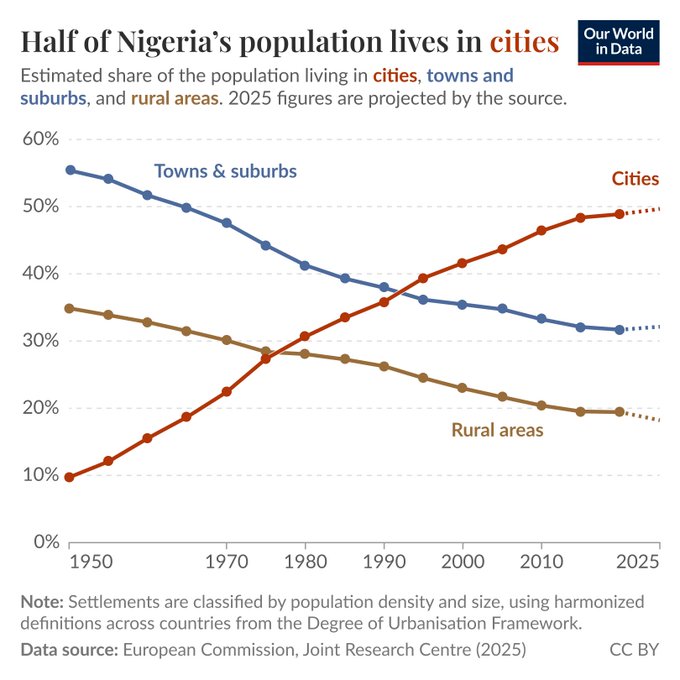
Estimated share of Nigeria's population living in cities, towns and suburbs, and rural areas, 1950-2025 (2025 figures projected). Source: Our World in Data / European Commission Joint Research Centre.
The share of Nigerians living in towns and suburbs - the country's largest settlement category as recently as 1950 - fell by roughly as much as the rural share over the same period. Nigeria's population became more concentrated in cities both through migration into established centres and through smaller towns and suburbs growing dense enough to be reclassified as cities in their own right, Our World in Data says.
Lagos remains the clearest example of the growth: population-tracking estimates put Nigeria's commercial capital at somewhere between 15mn and 17mn people depending on whether city-proper or metro-area boundaries are used, with the wider metro area adding roughly 1.1mn people a year, an annual growth rate of about 3.3-3.75%.
Nigeria's experience also breaks from the historical pattern in which rapid urbanisation tracked industrialisation, as it did in Europe, North America and, more recently, East Asia. Across much of today's sub-Saharan Africa, Our World in Data reports, city growth is happening without a comparable manufacturing base to absorb the new urban workforce - a structural gap that shapes the informal-economy and infrastructure pressures already visible in Lagos and other fast-growing Nigerian cities.
The IntelliNews PRO service includes access to reports, exclusive market data, and more news that decision-makers care about. Stay ahead of the market with IntelliNews PRO.
Sign Up Now

_1785480412.png)

