


Pashinyan puts Armenia on road to EU membership
19 hours ago
Civilian deaths in Ukraine hit a record monthly high in May, driven by a shortage of Ukrainian air-defence interceptors rather than a shift in Russian targeting as the Kremlin escalates its missile barrage, officials say.
Russia continues to target residential housing and has bombarded Kyiv in the last two weeks with some of the largest bombardments of the war. In the first two weeks of July more than 50 civilians have been killed already, according to the UN.
“Russia has directed attacks at major urban centres throughout the war. In fact, key centres such as Kyiv, Kharkiv, Odesa, Dnipro, and Lviv have been repeatedly targeted for coercive pressure, including experiencing multiple double-tap Russian strikes, which, for example sequentially target infrastructure and then emergency responders,” according to new research by the CSIS Futures Lab analysis of oblast-level damage reports from 2023 through early 2026.
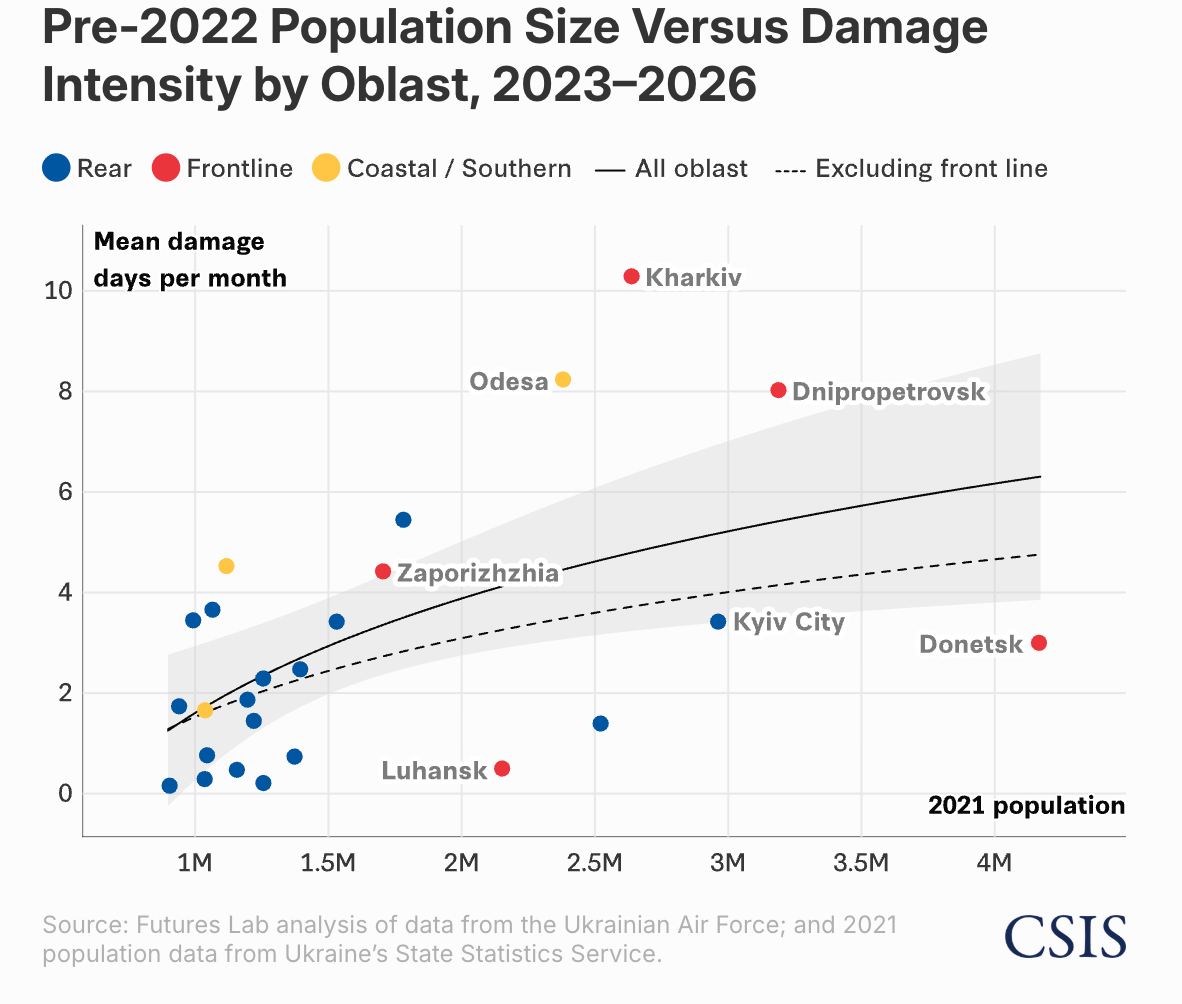
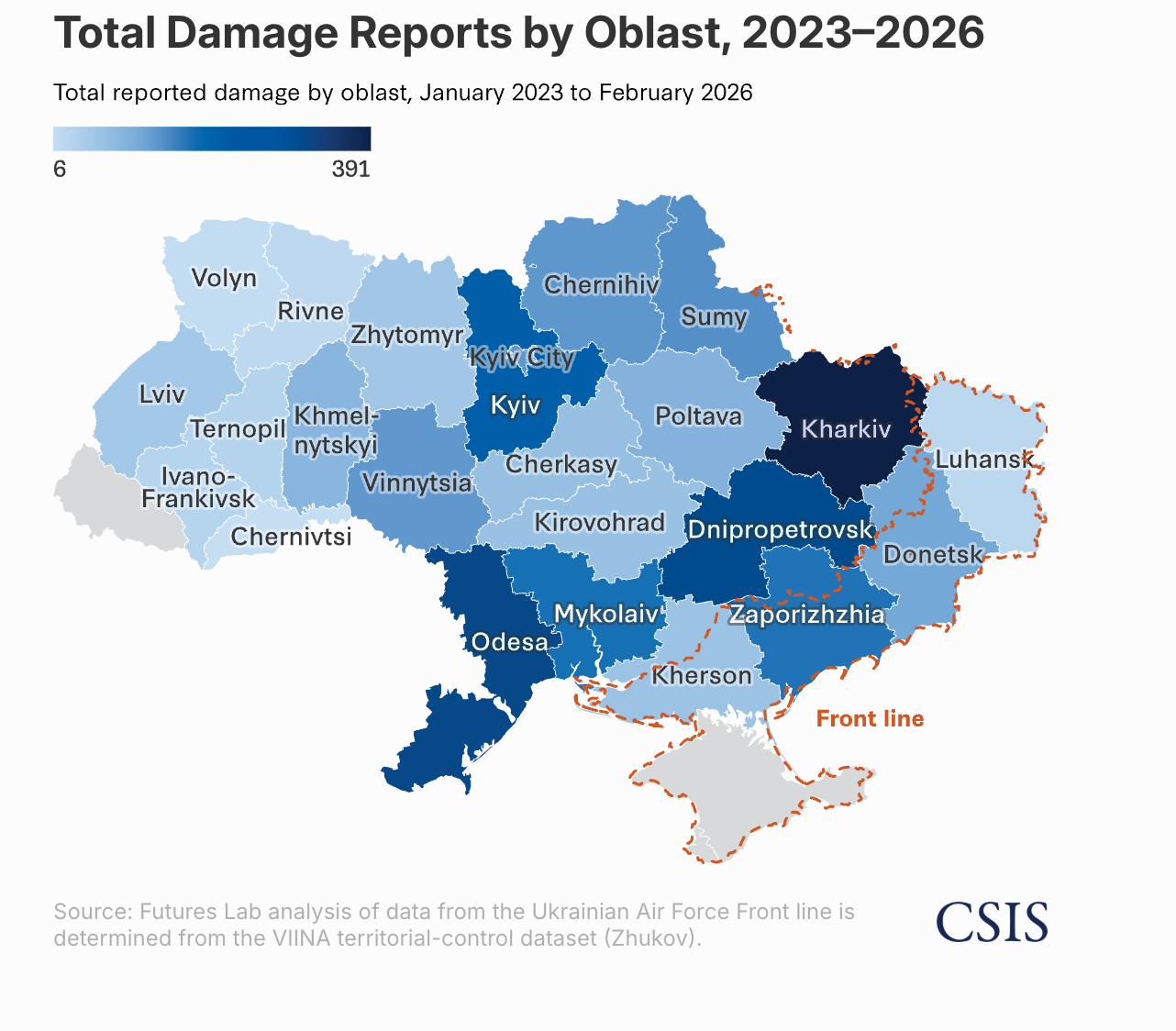
So, Russia is trying to terrorise Ukraine's population by hitting homes. Yes. But it’s more complicated than that. Russia’s missile and drone campaign in Ukraine is a coercive strategy built around geography, according to CSIS. That shows that reported damage in Ukraine has increased sharply, but it is also becoming more concentrated in frontline and southern regions, as well as areas with industrial, energy, and port infrastructure in addition to major urban centres.
“This pattern suggests that Moscow is using long-range firepower to disrupt logistics, strain critical infrastructure, pressure civilians, and impose cumulative costs on Ukraine’s ability to fight, repair, govern, and negotiate,” authors Yasir Atalan and Benjamin Jensen said in the report.
The Russian campaign has been shaped by the strategic value of targets, the rapid growth of Shahed-type drone launches, winter attacks against energy infrastructure, and the expansion of a drone-dense kill zone near the front.
Shahed drones did not enter the fray until September 2022, and only in the single digits that first month. By October 2022 that rose to 510 missiles and drones of all types and by the second half of 2025, Shahed launches alone totaled 5,000–6,000 per month.
“Russia uses firepower strikes as a form of coercion to impose military, economic, and psychological costs on the Ukrainian state and society so that Kyiv and its supporters will accept an outcome more favourable to Moscow—a classic punishment strategy,” CSIS said.
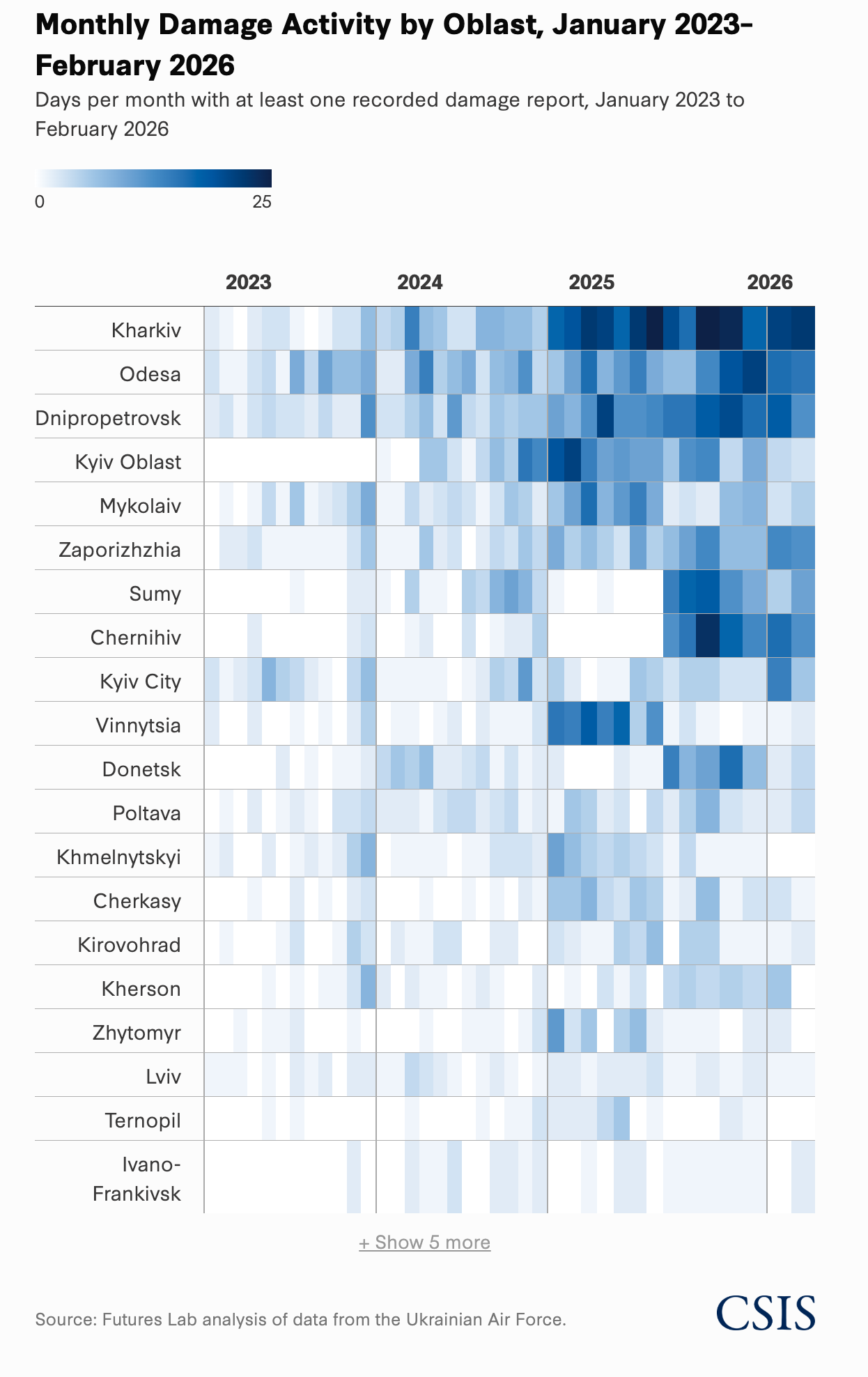
The analysis of Russian strikes reveals three overarching trends:
Russia’s reported strike damage has increased over time, while the geography of damage has become more concentrated in key target areas;
Many missile and drone attacks are aimed at logistical nodes that support Ukraine’s battlefield operations, especially in frontline and southeastern oblasts, where strategic strikes overlap with a denser ecosystem of artillery, glide bombs, FPV drones, and loitering munitions: and
Strategic industrial bases, energy infrastructure, ports, and major urban centers have become recurring targets as Russia seeks to raise the costs for Ukraine’s economy, civilians, and political leadership.
Attacks on critical infrastructure weaken the physical systems that allow Ukraine to move goods, repair damage, sustain industry, export commodities, and support military operations. Attacks on major cities and residential areas, meanwhile, apply psychological pressure and signal that civilian life will remain vulnerable as long as the war continues. All that is in addition to degrading the adversary’s ability to fight.
In addition, proximity still shapes Russia’s attacks. Western oblasts are targeted less often, with most reported damage remaining concentrated in eastern and southeastern Ukraine. Like Ukraine, Russia’s drone factory in the Alabuga Special Economic Zone in Tatarstan continues to innovate that allows Moscow to increase strike volume, depth, and frequency. Belarus’s operational role has also given Russia more options for routing drones and complicating Ukrainian air defense.
“Russian thinking connects this general coercive logic to a broader concept of strategic deterrence in which nuclear, conventional, informational, and nonmilitary tools are combined to shape adversary decisionmaking across peace, crisis, and war,” says CSIS.
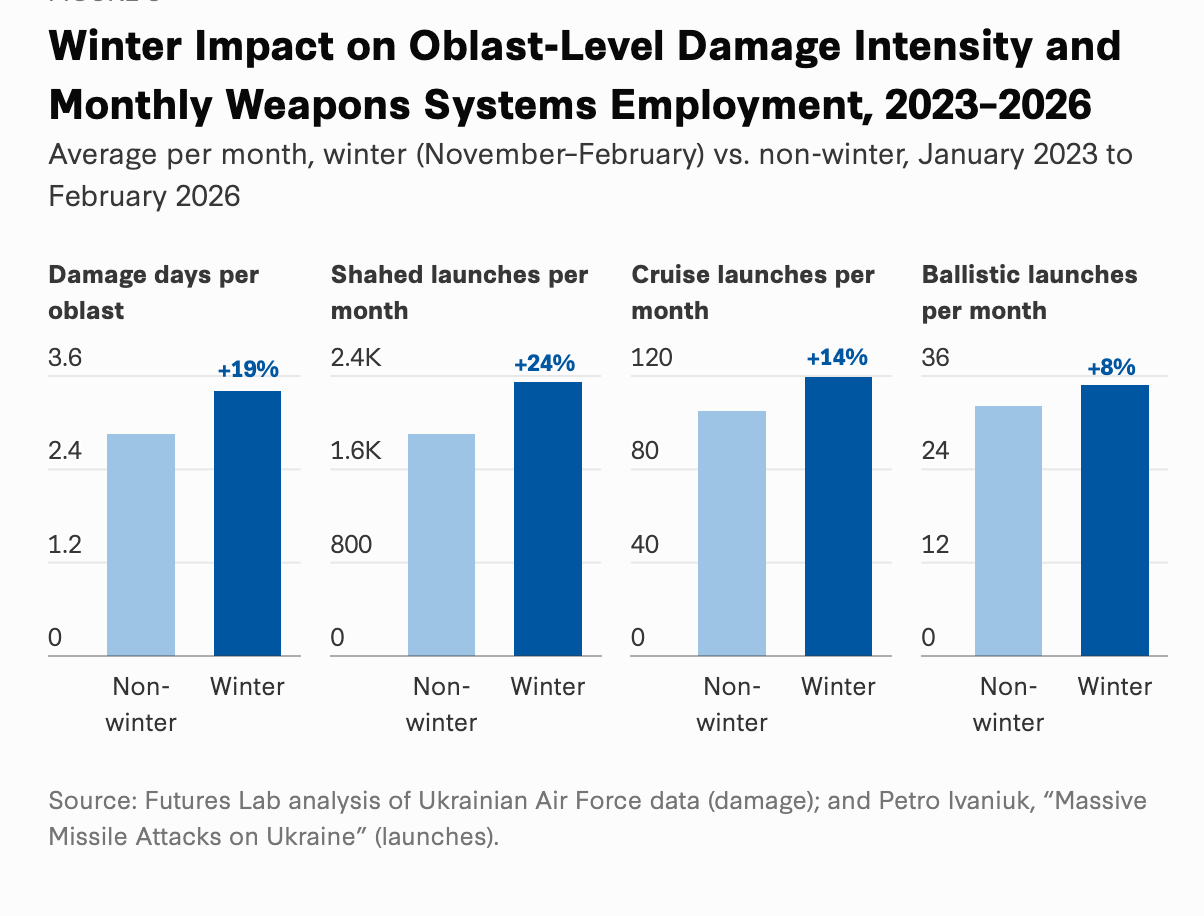
Drilling into the geographic strike patterns they are shaped by five broad considerations: target location, range scaling, Belarusian involvement, seasonal campaigning, and the expanding kill zone near the front, says CSIS.
CSIS analysis reveals that target proximity, specifically to the front line and to Russian launch areas, influences targeting decisions.
Russia’s growing use of Shahed-type one-way attack drones has allowed Russia to scale up long-range attacks.
Belarus appears be taking on an expanded role in Russia’s strike architecture by increasingly supporting routing, diversion, and navigation for loitering munitions.
The seasonal logic of Russia’s winter energy campaigns has helped shape targeting decisions.
The spread of drones, loitering munitions, glide bombs, and artillery has expanded the contested zone near the front, making the front line and nearby rear areas more vulnerable to repeated damage.
“When examined together, these factors explain why Russia’s campaign has not simply become larger over time but also shifted how—and where—strikes are concentrated, dispersed, and sequenced,” CSIS said.
The final factor explaining the evolution of the strike patterns is the changing character of the battlefield near the front. Over the last two years, the traditional concept of a static front line has increasingly dissolved into a chaotic, expanding “front zone.”
This has been the revolution that the change to modern asymmetric war has brough thanks to the cost-to-kill ratio becoming a major factor in conflicts; hundreds of cheap drones trump a few powerful and accurate missiles. Russia has both. Ukraine lacks boht the missiles and interceptors needed to bring Russia's missiles down.
But Ukraine does have millions of drones and that has resulted in a kill zone that extends up to 30km from the forward line of contact and is characterized by mixed, overlapping positions where soldiers must prioritize basic survival and distinguishing friend from foe is highly difficult. Conventional warfare of position-vs-position has given way to a stochastic war that is entirely unpredictable and positions have become indefensible.
“In this environment, conventional linear warfare involving position-against-position combat has been replaced by isolated small teams that are sustained entirely by drone-based supply lines.,” the authors said. And as drone innovation continues this indefensible “front zone” is expanding fast. The traditional fortified trench has been replaced by the drone pilot position and much more fluid fighting.
Ukraine’s targeting strategy
As the war moves into the air, both sides have adopted what Dr. Karl Mueller called the “power of coercive air power.” Moscow has been following this strategy since the beginning thanks to its advanced missile production and technology, but it has only become an option for Ukraine relatively recently after its investments into drone technology has produced a raft of new classes of drone. The coercer aims to shape the adversary’s course of action by making a particular option appear more attractive than the alternatives.
By contrast, the Armed Forces of Ukraine (AFU) says it goes out of its way to avoid the so-called collateral damage and strictly sticks of hitting military and industrial targets.
That claim has been supported by the sustained and escalating attacks on Russia’s oil refineries that has caused a country-wide fuel crisis, but it has been more recently put under the spotlight following a Ukrainian attack on the Russia-controlled university town of Starobilsk in the Lugansk region in Donbas in May that killed 21 people – mostly teenaged students in their beds in a dormitory. There have also been numerous attacks on towns on the Russian side of the border on civilian railways and other logistics assets that have killed civilians. Bankova claim there was a military target in Starobilsk. The Kremlin said there is not. Independent media access to Starobilsk was not granted.
Ukrainian strikes on Belgorod's energy grid has killed civilians but UN monitors have been unable to verify the competing claims. Those cases turn on individual targeting decisions and the evidence available to check them, not on the broader mechanics of missile stocks and refinery repair schedules.
The conflict is escalating and increasingly turning into a competition between drones vs missiles, where Russia has the overwhelming advantage in the latter. As the war goes into its fifth year, Russia uses a mix of ballistic missiles, cruise missiles, glide bombs, one-way attack drones, and first-person-view (FPV) drones to pressure Ukraine across different parts of the battlefield and in the rear.
“Because these systems serve varying purposes, glide bombs and artillery-heavy strikes are concentrated closer to the front, while ballistic and cruise missiles target higher-value infrastructure and military targets. Shahed-type one-way attack drones meanwhile enable Russia to expand the scale, frequency, and geographic reach of its strike campaign at relatively little expense,” says CSIS.
Both sides are using the escalation of the drone war to coerce the other to come to the negotiating table with improved terms. The exchange has descended into a slugfest of inflicting as much pain on the other in the hope to forcing them into talks. The upshot is both sides are more willing to engage in talks, but neither side is willing to backdown.
The slugfest has made bolstering Ukraine’s dwindling air defences critical. At the Ankara Nato summit Ukrainian President Volodymyr Zelenskiy said that Ukraine has already won on the water, pushing Russia’s Black Sea Fleet out of its home port in the Crimea, and its drone operators have brought the war on the land to standstill. “Now the war is going to be fought in the sky,” Zelenskiy told his Nato allies.
Russia is "deliberately exploiting Ukraine's shortage of Patriot interceptor missiles," Ukrainian air force spokesman Yuriy Ihnat said last week. Ballistic missiles are Russia’s “last advantage” Zelenskiy said in Ankara, against which Kyiv currently has almost no defences.
The missiles have not changed much. What stops them has.
Ukraine's long-range campaign against Russia is more focused than Russia’s. It has been specifically oil, gas and military-industrial has surged in the last year, primarily targeting Russia’s oil refineries. The attacks have also been scaled up with high profile barrages on the key Baltic oil terminals of Primorsk and Ust-Luga in June, again on St Petersburg oil facilities on the day Russia’s flagship St Petersburg International Economic Forum (SPIEF) opened and Russia’s ASEAN summit in Kazan shortly afterwards. While these attacks were on industrial targets, there was clearly a strong propaganda angle to them.
An independent analysis published by Meduza in May found the frequency of Ukrainian strikes deep inside Russia has held at more than 30 verified attacks a month since mid-2025, with "no surge in strike intensity in 2026," despite a run of high-profile hits on Moscow, Tuapse, Perm and other oil towns.
What has changed is precision rather than volume, as Ukraine’s drone tech is clearly advancing rapidly. Ukraine's military has increasingly targeted refinery components that take longer to repair than just the refineries themselves. More accurate drones can go after the distillation units, rather than randomly striking the facilities themselves, according to Sergei Vakulenko, a senior fellow at the Carnegie Russia Eurasia Center.
Previously, the small payloads of Ukraine’s drones could set fires but the damage was superficial and repaired in a matter of days. By destroying specific equipment that was imported, sanctions delay or prevent repairs. A hit on the Moscow refinery in July has taken it out of action for the rest of the year, due to the difficulty the owners have in finding spare parts.
Ukrainian drones have hit Russian refineries at least 194 times so far this year, the Financial Times reported in June, citing Polish analytical group Rochan Consulting, with the share of strikes on genuinely new targets holding at 10-20%, largely unchanged from a year earlier. Kyiv describes the campaign as "long-range sanctions" rather than a bombing surge.
The casualty pattern on Russian territory has not shown a comparable monthly climb: Russian authorities reported 47 civilian deaths across the country in May, and independent outlet Fonar's cumulative estimate for the worst-hit Belgorod region, 429 dead since 2022, has accumulated gradually rather than spiked.
Read together, the shifting patterns of strikes and targeting point to the same mechanism: each side adjusting to the other's defences and repair capacity, rather than to a shift in either government's stated targeting doctrine.
Russia's published categories, logistics, energy and urban pressure, are the same ones CSIS documented before the interceptor shortage became acute. Ukraine's own targeting categories have similarly held steady, according to a PILPG review, concentrated on oil and gas export infrastructure and military supply lines.
The quartermasters and repair crews are shaping this year's casualty count as much as the generals are -- and for now, that is the part of the story that holds up against the data.
The interceptor gap
Is Russia deliberately targeting civilians with missiles in order to terrorise the Ukrainian population?
The UN Human Rights Monitoring Mission in Ukraine (HRMMU) has recorded a steady rise in verified civilian deaths through 2026: 161 in January, 191 in February, 211 in March, 238 in April and 274 in May. Long-range missiles and drones caused 36% of civilian casualties in March and 45% in May, the mission said, with most deaths occurring in cities far from the front line.
The rise coincides with a well-documented shortage of Patriot interceptors; the only system Ukraine has capable of shooting down ballistic missiles. Stocks of the PAC-3 interceptor missiles have become so low that the AFU has started to ration them, firing only one rather than the usual two or three to bring down an inbound missile. The AFU has also been using the interceptors in manual mode to avoid them chasing slower, less sophisticated targets, like drones, which can be downed by other cheaper means. The situation is reminiscent of the artillery shell shortage that plagued the AFU in the second year of the war when it also ran out of ammo..
Ukraine’s ballistic missile interception rate has collapsed dramatically — from 40% at the beginning of the year to 20% in spring, and nearly 0% by mid-summer, according to Forbes Ukraine. Ukraine intercepted none of 23 Iskander-M ballistic missiles and six Zircon and Oniks missiles fired at Kyiv on July 6, air force data showed; for the month, Ukrainian air defences downed just four of 49 ballistic missiles fired at the country.
The shortage of interceptors is global, not Ukraine-specific: production of Patriot interceptors has been stretched by simultaneous demand from conflicts in the Middle East, leaving Kyiv competing with other buyers for a dwindling supply.
With Patriot missile stocks running critically low, US President Donald Trump has promised Zelenskiy a licence to make Patriot missiles during the Nato summit. However, as IntelliNews reported it could take years to set up a factory and the need for air defence is now. Patriot interceptors are amongst the most complex missiles in the world and strict American technology controls as well as severe supply chain shortages means Ukraine is unlikely to be able to make domestically produced interceptors for several years.
The IntelliNews PRO service includes access to reports, exclusive market data, and more news that decision-makers care about. Stay ahead of the market with IntelliNews PRO.
Sign Up Now


