


Kazakhstan manufacturing conditions decline to worst degree since March 2022, PMI shows
4 hours ago
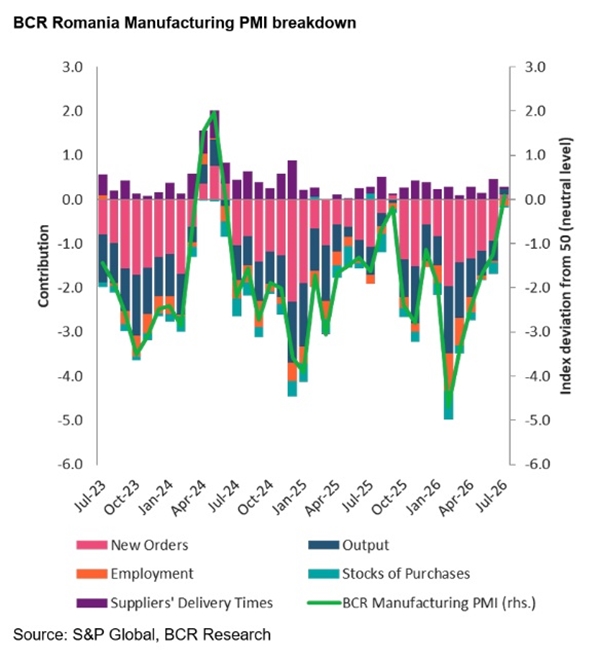
Romania’s manufacturing sector showed signs of stabilisation in July, with the BCR Romania Manufacturing PMI (chart) rising above the 50-point threshold for the first time in just over two years, although weak external demand, high energy costs and the struggling automotive industry continue to weigh on activity.
The PMI rose to 50.1 in July from 48.8 in June, according to a research note from Erste Group. The improvement was driven by increases in the output and new orders sub-indices, but the rise in new orders was entirely attributable to domestic demand, with no corresponding improvement in external orders.
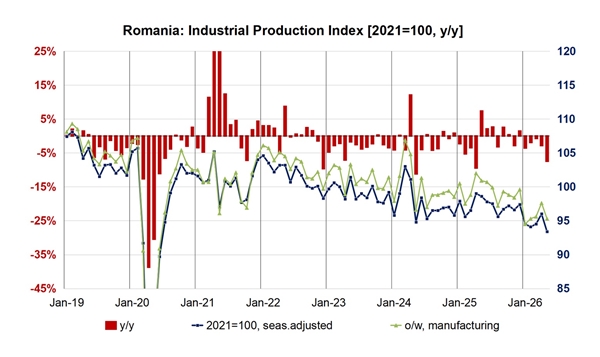
The latest PMI reading contrasts with official industrial data, which point to continued contraction. Romania’s industrial output fell 3.3% y/y in January-May (chart), while manufacturing output declined 4.5%. Energy-intensive industries have been among the sectors most affected by high energy costs, while light industry has faced increasing competition from lower-cost foreign producers.
Oil refining output has fallen by 21.2% over the past five years, while automotive manufacturing has declined by 19% as the industry adjusts to electrification and rising competition from Chinese manufacturers.
Based on manufacturing output remaining at its May level, the sector would contract by 3.3% for the full year, according to our calculations. This would follow annual declines of 1.1%-1.2% in 2024-2025 and a 2.5% contraction in 2023.
A significantly stronger industrial recovery, with PMI readings consistently above the 50-point threshold, would therefore be needed merely to bring manufacturing output to annual breakeven this year.
Erste Research cautioned against interpreting the July PMI as evidence of a sustained recovery. “Considering the weakness in hard data after the first five months of the year, though subject to some revisions, Romanian manufacturing output seems on track to head into the fourth consecutive year of contraction,” the analysts said.
The expected improvement in external demand has yet to materialise despite more positive indicators from Germany, Romania’s key trading partner. Germany’s flash manufacturing PMI remained above the 50-point no-change mark for a sixth consecutive month in July, with output recording its strongest increase in almost four-and-a-half years. However, this has not yet translated into higher foreign orders for Romanian manufacturers, while the longer-term impact of increased European defence spending is expected to vary across industries.
The IntelliNews PRO service includes access to reports, exclusive market data, and more news that decision-makers care about. Stay ahead of the market with IntelliNews PRO.
Sign Up Now


_0_1785753234.png)
