


Stopping dog meat sales in Indonesia is more about shuffling paperwork than morality
6 hours ago
De-dollarisation is gathering momentum, but the process of switching to settling global trade in multiple currencies is going at a glacial pace. The problem is that once glaciers start moving, they are impossible to stop.
The Chinese yuan is the leading contender to replace the dollar. Globally the yuan still accounts for a small share of international trade, but there are growing pockets where it dominates. In Russia’s case, Beijing and Moscow settle almost all their trade in national currencies now, up from nothing pre-war. That makes a large patch of land in what was the Soviet Union that is now almost de-dollarized already.
Dollar sinking value
The slow exodus from the dollar is already starting to impact its value, which has declined by 10% year-to-date, marking its weakest annual performance in over two decades. While the US stock market continues to boom—particularly in the tech sector—foreign investors are shedding exposure to dollar-denominated assets, including Treasury bills, at what Deutsche Bank described as “an unprecedented pace.”
“The trend raises a critical question: if the world’s wealthiest nations keep accumulating debt without clear growth or reform strategies, what will back their obligations tomorrow?” Kate Martin asked, writing in the Financial Times.
US debt has now topped $37 trillion, or 137% of GDP, which is starting to spook investors. By contrast, Russia’s total debt is RUB26.5 trillion ($290bn), or 17-20% of GDP, which should make it one of the strongest currencies in the world. Russia can cover its entire debt more than two-times over with just its cash in the bank.
The dollar’s declining share in global reserves and the rise in currency-hedged equity inflows suggest that even as investors chase returns, they are increasingly protecting themselves from the risk of continued dollar weakness.
According to the FT, more than 80% of inflows into US stocks are now hedged against dollar depreciation, up from near zero at the beginning of the year. “It’s starting to look like a game of musical chairs,” Martin observed. “As long as the music is playing, investors are still chasing returns—but the music will eventually stop.”
Yuan waiting in the wings
An exporting powerhouse Beijing has followed a careful policy of ensuring its trade is largely balanced with most of its partners which makes setting deals in mutual national currencies easy. The US has taken its eye off the ball and allowed large imbalances to build up. Trump’s Liberation Day tariffs is a crude attempt to undo this problem.
Russia used to run a modest deficit with China for the first two decades of the Putin regime. But as soon as the West imposed its extreme sanctions regime and cut Moscow off from the lucrative EU markets, Russia has been forced to turn to China which threw it an economic lifeline. Now Russia runs a healthy trade surplus with China, which China pays for in yuan, giving Moscow access to a flow of yuan that it can use to replace the dollar.
In 2020, Russia imported from China goods worth about $54.91bn, which was about 23.7% of its total imports, and exports to China totalled about $49.15bn – a trade deficit of a mere $5.8bn. By 2023 the total trade turnover was about $240bn with Russia running a surplus of about $13.83bn in 2024 and $12.16bn in the first half of this year – still a relatively modest level compared to the overall volume of trade.
In the same way that the EU opened its market to Ukrainian goods by dropping all duties, but unlike in Russia’s case it ran a $20bn trade deficit with Europe that has ballooned to a $40bn deficit and it’s getting worse as those duties were reimposed in June.
Local de-dollarised regions emerge
“The dollar is currently unreliable, and Russia does not use it,” Russian Finance Minister Anton Siluanov at the Financial University's international forum "Russia: Vision of the Future" on November 25.
According to him, Moscow does not have the goal of de-dollarisation, but does have the goal of ensuring stable settlements.
While the dollar still dominates global trade settlements, in localised regions and especially amongst the Eurasian Economic Union (EUU) and BRICS members, its use has fallen drastically and largely replaced by the Chinese yuan. As part of the yuanisation of the Russian economy, its use has fallen to next to nothing.
However, the development of a cross-border settlement system within the group is "rather sticky," as not everyone is "ready to participate." Siluanov noted that many are satisfied with dollar settlements.
The yuan is still a long way from replacing the dollar. The Chinese currency’s share in international finance accounts for only 4% of global payments and just 2% of central-bank reserves. However, internal reforms have enabled China to double the yuan’s share in international payments since 2022.
The use of preferred currencies to settle trade bills is closely connected to what goods are being paid for. Since the start of the Ukraine war, Asia has completely replaced Europe as Russia’s best customer for oil. Russia has shifted 90–95% of its mutual trade settlements with India and China to national currencies, Deputy Prime Minister Alexander Novak said on October 20, Vedomosti reported.
Over 30%-50% of China’s trade is now conducted in yuan, up from 14% in 2019. More than half of all cross-border receipts are settled in the currency, compared with less than 1% in 2010. Cross-border trade settled in yuan has been growing at an average annual rate of 30-40% in past years. Chinese manufacturers invest overseas in yuan, or foreign companies or governments borrow yuan from Chinese banks.
"The market itself meets the needs for settlements in national currencies. For example, with our friends from China and India, 90–95% of our trade has already switched to national currencies. This is automatic, without any purpose, because they don't allow settlements in the respective currency, which was the hegemonic one," Novak stated, referring to restrictions on dollar-denominated transactions.
He added that the transition has not hindered bilateral trade. The move reflects broader efforts by Russia to reduce reliance on the dollar and other Western currencies in the face of sanctions and financial restrictions.
Earlier, on October 15, Novak said India had begun settling oil payments in Chinese yuan, though the share of such transactions remained limited. He noted that the majority of oil trade with India is still settled in rubles, without specifying the proportion.
FX decoupling
As the role of the dollar decreases its importance in portfolios falls and that is leading to a decoupling of exchange rates that used to move in lockstep.
“A regime change is happening in global FX. Currencies that used to be cyclical and volatile are becoming safe havens, as markets seek out countries with low debt. That's the Swedish Krona, which now has a higher correlation with gold than Swiss Franc,” economist Robin Brooks says.
Due to Russia’s problems now all the Global Emerging Markets (GEMs) are looking for a convenient way to dump the dollar – and many of them are turning to digital solutions. At the BRICS summit in Kazakh last year, Russian President Vladimir Putin showcased the BRICS Pay digital currency that could become an alternative to the dollar. It is not a genuine cryptocurrency, but rather an amalgam of the digital versions of the leading BRICS currencies that could be used to settle commodity payments, including the digital ruble.
In parallel, Beijing has expanded its non-dollar alternative infrastructure, including the Cross-Border Interbank Payment System (CIPS), which now counts over 1,700 member banks globally and handled CNY175 trillion ($24.7 trillion) in transactions last year. The CIPs platform has already eaten into the volume of yuan traded on SWIFT, the pre-eminent Western money transfer system.
China has also increased digital yuan trials, notably through the mBridge platform—a blockchain-based cross-border payment network co-developed with other central banks.
China also is deploying swap lines and local currency lending to build confidence in the yuan. It has signed CNY4.5 trillion ($630bn) in currency swap agreements with 32 central banks including yuan-denominated “panda bonds” in Hungary and Russia, as well as negotiations with Kenya and Brazil over new debt instruments.
Selling off T bills, buying gold
The use of the dollar in trade has been sticky as the system is well established and the pools of liquidity deep, but after CBR sanctions seized over $300bn of Russia’s foreign currency reserves at the start of the Ukraine war, central bankers around the world were freaked out and have rushed to reduce their exposure to the dollar. That meant nobody’s international reserves were safe anymore. The Trump administration’s aggressive Liberation Day tariff regime has only catalysed a process that was already underway.
Russia sold off all its dollar assets even before the war started and replaced it with yuan. In the meantime, it has also sold its euro holdings and increased gold to a third of a total – and earned a bonus $100bn from the inexorable rise in the value of gold in the last three years. Reserves now top $700bn, an all-time high, largely because of the revaluation of its 2,360 tonnes of monetary gold. Russia has by far the highest percentage of debt backed by gold among major economies at 65%. Next best is Switzerland with 38%, followed by Germany with 14%.
China is likewise selling off its US T bills and stocking up on gold for similar reasons. From a peak of over $1.3 trillion in 2013, China’s holdings fell to $778bn by September 2023 and have continued to decline into 2024 and 2025.
China’s Treasury holdings as a share of all foreign holdings is down to 7.6%, the lowest in 23 years. This percentage has declined by 20 points over the last 14 years. As a result, China now ranks as the world’s third-largest foreign Treasury holder, after previously being in the top spot for years.
By contrast, during the same period, the UK’s percentage has quadrupled, to 9.4%, near the highest on record. Japan is now the biggest holder of US debt, but it has also been pulling back. The share of US Treasuries in its reserves has declined 26 points over the last 21 years, to 12.9%, near the lowest this century.
For decades, US Treasuries were the global safe haven, but that appears to be changing, as Central Banks worry about America’s growing indebtedness and seek to diversify their exposure away from the dollar -especially after it lost its AAA rating from all the main rating agencies between 2021 and 2025. Today only 11 countries have a triple-A rating from all three ratings agencies, including Germany, Australia, Canada, Sweden, Norway, and Switzerland. France, the UK and Italy are noticeably absent from this list.
At the same time, China has significantly increased its physical gold reserves. The People’s Bank of China has been purchasing gold steadily since late 2022, adding more than 200 tonnes by the end of 2023. As of mid-2025, official gold holdings exceed 2,300 tonnes, though analysts believe actual reserves may be higher due to opaque off-market acquisitions. Pointedly, China recently returned its physical gold to Beijing and has offered to hold the gold of other countries.
|
Rank |
Country |
Gold Reserves (tonnes) |
Current Value (USD bn) |
Debt Backing (%) |
|
1 |
USA |
8,133 |
1,052 |
2.87 |
|
2 |
Germany |
3,352 |
434 |
13.92 |
|
3 |
Italy |
2,452 |
317 |
9.02 |
|
4 |
France |
2,437 |
316 |
8.58 |
|
5 |
Russia |
2,333 |
302 |
65.43 |
|
6 |
China |
2,299 |
298 |
1.97 |
|
7 |
Switzerland |
1,040 |
135 |
36.44 |
|
8 |
Japan |
846 |
110 |
0.97 |
|
9 |
India |
880 |
114 |
3.21 |
|
10 |
Netherlands |
612 |
79 |
16.88 |
Source: Central bank data
And it’s not just China and Russia doing it: foreign central banks now own more gold than US Treasuries for the first time in 30 years, Bloomberg reports.
Between them, selling US assets and accumulating gold is the same policy as Russia has followed for years and effectively sanction-proof the economy.
As part of a broader de facto de-dollarisation policy, China is also actively promoting the use of the yuan in international trade and financial agreements, especially with countries like Russia, Iran, and members of the BRICS bloc. Beijing’s first push to boost yuan use began in 2009 but ended abruptly in 2015 with capital flight, The Economist reports. Now it is having another attempt.
Domestically, China is stamping out the use of the dollar for credits. In 2022, only 15% of loans were issued in yuan; by mid-2025, that figure has climbed to nearly 50%.
Dollar share of reserves falling
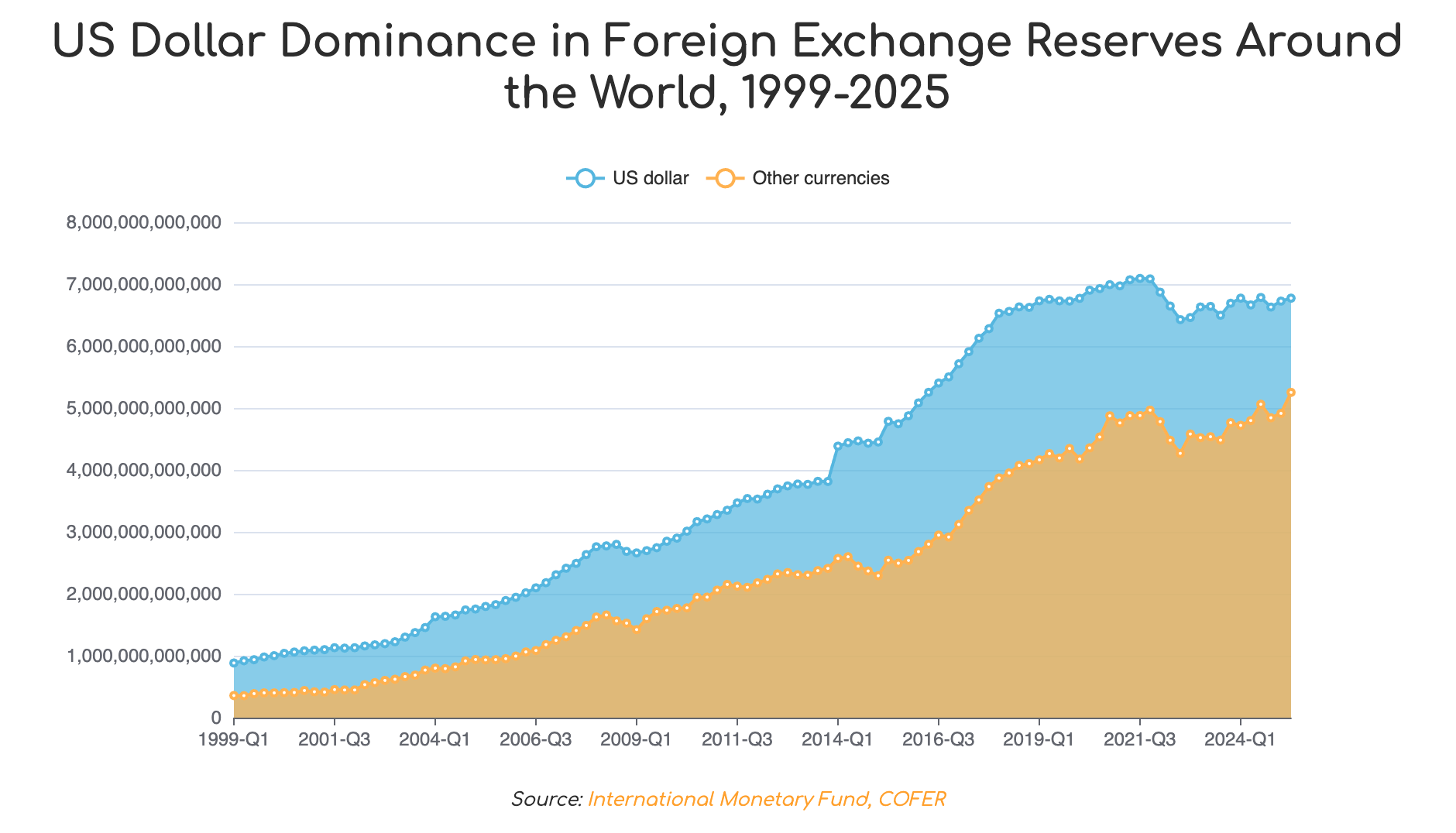
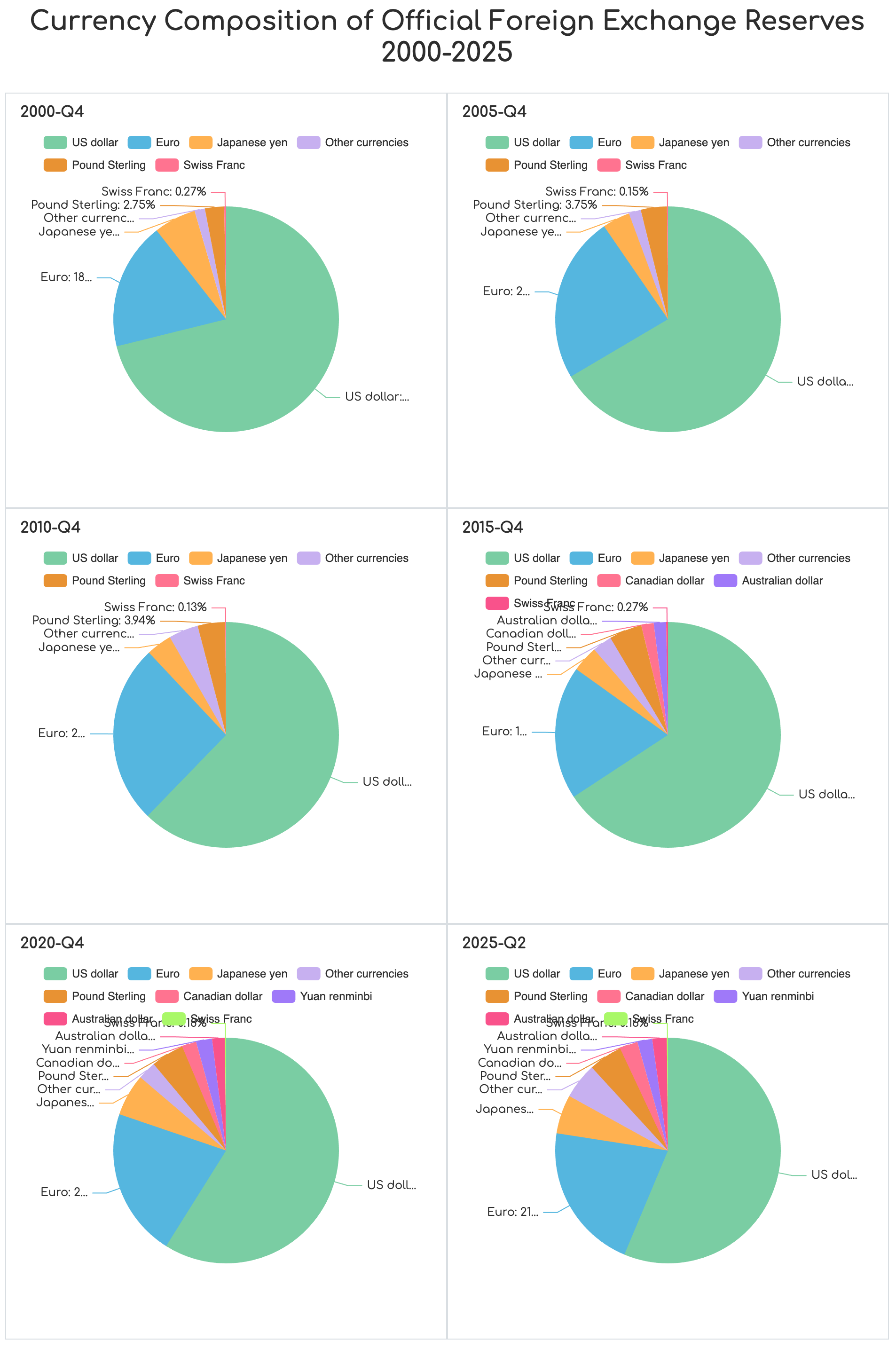
More generally, the share of dollars in countries’ international reserves have fallen to a multiyear low. Between 2000 and 2025, the US dollar's share of foreign exchange reserves around the world went from 71.2% to 56.3%, a difference of almost 15 percentage points over the course of 25 years.
The most recent figures show that global foreign exchange reserves reached approximately $12.94 trillion in the second quarter of 2025, up from $12.54 trillion in the previous quarter, according to BestBrokers. However, currently, the value of the allocated currency reserves held in dollars is $6.77 trillion, compared to a historic high of $7.1 trillion in the third quarter of 2021, and up from $2 trillion in 2020.
The euro has been a big winner from the decline of the dollar's popularity, with the share of Euro-denominated reserves increasing from around 18% to 21.1% between 2000 and 2025, but still less than the previous peak of 26% in the early 2010s.
“The US dollar has depreciated against major currencies this year - the DXY, which measures the greenback against six currencies, dropped more than 10% within the first six months of the year, the most significant in over 50 years,” BestBrokers said in a recent report. “At the same time, in 2025, the US dollar's share of global foreign exchange reserves dropped to a historic low of 56%.”
Drilling into the International Monetary Fund (IMF) Currency Composition of Official Foreign Exchange Reserves (COFER) data, the analysts found that between the first and the second quarter of 2025, the euro-denominated global allocated reserves increased by 9.13% when measured in dollars.
“This is the greatest increase in nominal value among all major currencies. Euro-denominated reserves grew to $2.54 trillion at the end of Q2, reaching 21.13% of all reserves,” says BestBrokers.
|
Composition of Allocated Foreign Exchange Reserves at the End of Q2 2025 |
||
|
Currency |
Value (Q2 2025) |
Change from Q1 2025 |
|
US Dollar |
$6.77 trillion |
0.72% |
|
Euro |
$2.54 trillion |
9.13% |
|
Japanese Yen |
$670bn |
2.89% |
|
Pound Sterling |
$580bn |
5.26% |
|
Canadian Dollar |
$314bn |
2.50% |
|
Yuan Renminbi |
$255bn |
3.30% |
|
Australian Dollar |
$251bn |
6.75% |
|
Swiss Franc |
$19bn |
–7.82% |
|
Other Currencies |
$622bn |
8.61% |
|
Source: BestBrokers. IMF |
||
However, the IMF itself points out that a lot of this change has more to do with the sinking value of the dollar than an increase in the fundamentals of the euro.
“The valuation effect effectively obscures the direction of change of the underlying movement in the currency. Similarly for the pound: the valuation effect obscures the direction of change: the share appears to have gone up when, holding exchange rates constant, the share would actually have gone down,” the IMF said in a recent blog, which tracks exchange rate adjusted central bank reserves using its “Currency Composition of Official Foreign Exchange Reserves (COFER)” metric.
Meanwhile, the share of non-dollar, non-euro currencies grew substantially. In 2000, these accounted for 10.6% of global reserves; by mid-2025, the figure had reached 22.6%, with smaller currencies—including the Canadian and Australian dollars, Swiss franc, and Korean won—increasing their combined share from 1.5% to 5.2%.
“The euro’s modest rise and the steady swelling of “other currencies,” which now account for 22.6% of reserves, underscore a broader reality: central banks aren’t abandoning the dollar, but they are quietly hedging against a world that no longer revolves around a single anchor,” says Paul Hoffman, lead data analyst at BestBrokers.
Emerging market debt soaring
The flip side of the same story is while the dollar’s appeal wanes, central bankers, hunting for an alternative, have been buying emerging markets bonds.
Investors are fleeing traditional quality markets in the face of soaring borrowing costs, mounting debt and flagging economies. Britain's 30-year borrowing costs rose to their highest levels since 1998 in September and sterling slid as the UK’s debt continues to mount. The Chancellor of the Exchequer, Rachel Reeves, was forced to hike taxes again this year, despite pledging not to when taking office. France’s government has already collapsed as parliament has failed to address the swelling budget deficit. And Germany is facing similar, if less acute, problems. Rising G7 debt is back at the centre of a bond market storm amongst some of the world's biggest economies that no one wants to admit to.
Investor appetite for emerging market debt has overtaken demand for sovereign bonds issued by the US and its peers in Europe as the situation continues to deteriorate. Europe can’t afford to take over the burden of supporting Ukraine since the US exit, as most EU countries are either in recession or approaching a crisis thanks to the boomerang effect of sanctions, according to Kate Martin writing in the Financial Times.
From 2010 to 2016, the government debt market of developed countries was roughly three times the size of that of emerging markets. Today, that dynamic has reversed.
“Persistent fiscal deficits, rising debt levels, and weakening economic prospects in G7 nations have eroded confidence. Meanwhile, many emerging economies offer higher yields, stronger growth potential, and improved macroeconomic stability,” Martin wrote.
Popular amongst the punters are the bonds of India, Indonesia, Brazil, and Mexico, while investors have become increasingly cautious of the increasingly unsuitable debt levels in the US, Japan, and much of Europe.


