

_0_1785753234.png)

Uzbekistan’s dismissed energy minister reportedly detained over abuse of office, embezzlement allegations
5 hours ago
Europe has increased its military aid to Ukraine this year, but it has failed to offset the departure of the US and the leading EU allies are still trailing far behind their Nordic neighbours.
European military aid to Ukraine fell significantly in the second half of 2025, with new pledges failing to compensate for the suspension of US support and overall allocations projected to reach their lowest level since Russia’s full-scale invasion began in 2022, the Kiel Institute for the World Economy reported on December 10.
Most of the European support for Ukraine has come from the top right-hand corner of the EU, the countries that are closest to Russia. Denmark, for example, has contributed over €10bn to Ukraine since the start of Russia's full-scale invasion in 2022, equal to nearly 3% of its gross domestic product. Spain, on the other hand, has given €1.48bn, or less than 0.2% of its GDP, according to the Kiel Institute, a think tank that tracks contributions. All of the Nordic countries have committed multiple times more to Ukraine in terms of a share of their GDP, than their peers in western and southern Europe have.
"The fact that the Nordic countries, with less than 30mn people, we provide for one-third of the military support that the Nato countries, with almost 1bn people, provide this year ... This is not sustainable. It's not reasonable in any way. And it says a lot about what the Nordics do — but it says even more about what the others don't do,” Maria Malmer Stenergard Sweden's foreign minister warned in November.
According to the latest update of the Ukraine Support Tracker, Europe committed approximately €4.2bn ($4.5bn) in new military aid through October—far short of the levels required to replace absent US contributions. Annual global aid to Ukraine, which averaged €41.6bn ($44.7bn) from 2022 to 2024, has so far reached only €32.5bn ($34.9bn) in 2025, with just two months remaining in the year.
“Based on the data available through October, Europe has not been able to sustain the momentum of the first half of 2025,” said Professor Christoph Trebesch, head of the Ukraine Support Tracker. “The recent slowdown makes it difficult for Europe to fully offset the absence of US military aid in 2025. If this slower pace continues in the remaining months, 2025 will become the year with the lowest level of new aid allocations ever for Ukraine since the outbreak of the full-scale invasion in 2022.”
The slowdown follows a record-high start to the year, but aid pledges declined sharply over the summer and continued to fall in September and October. To match previous years, an additional €9.1bn ($9.8bn) would need to be allocated before the end of December—more than double the recent monthly rate.
Despite the broader decline, a few European powers increased their military support. Germany nearly tripled its average monthly allocations compared to 2022–2024, while France and the United Kingdom each more than doubled theirs. However, measured against 2021 GDP, all three remained below the relative contribution levels of Nordic countries such as Denmark, Finland, Norway, and Sweden.
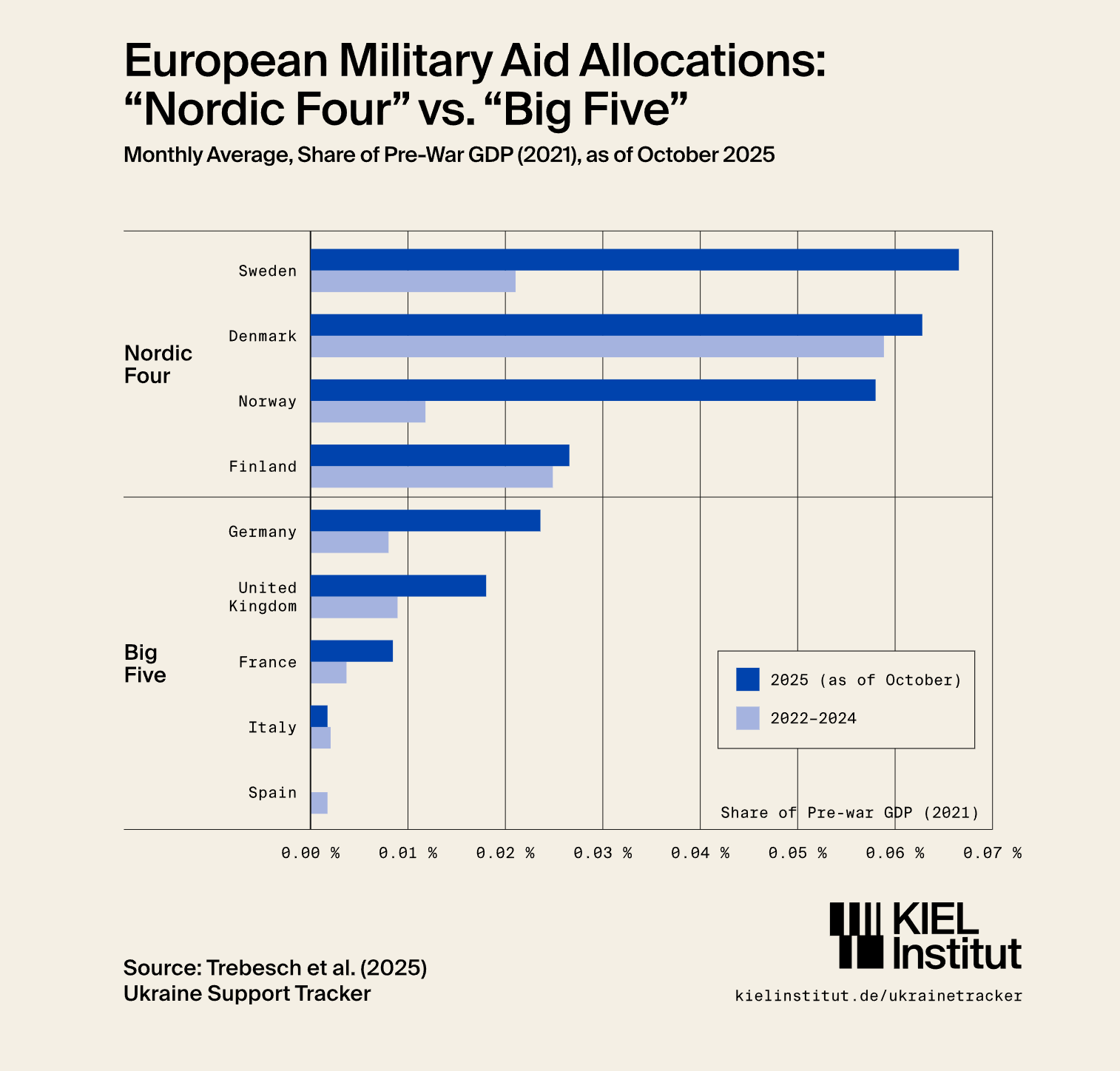
“The higher allocations from France, Germany, and the UK are significant,” said Taro Nishikawa, project lead of the Ukraine Support Tracker. “But even these three still trail the Nordic countries in relative terms. Meanwhile, the decline of support from Spain and Italy is a notable setback, reinforcing the importance of more balanced burden-sharing across Europe.”
Italy and Spain showed minimal engagement in 2025. Italy reduced its military support by 15% compared to 2022–2024, and Spain reported no new military aid pledges at all. This divergence further weakened Europe’s collective response, according to the report.
The Kiel Institute warned that without a sharp increase in aid commitments over the final months of 2025, Ukraine could face a widening shortfall in military and financial support heading into 2026.
The IntelliNews PRO service includes access to reports, exclusive market data, and more news that decision-makers care about. Stay ahead of the market with IntelliNews PRO.
Sign Up Now


