


Tehran lifts pollution emergency as air quality improves
1 day ago
Europe is turning into an underground desert as groundwater reserves are severely depleted due to intensifying climate impacts and long-term overextraction, according to a new study reported by The Guardian on November 29.
The findings have rung alarm bells as future supplies of drinking water will literally dry up, food production will plummet, and swaths of the Continent will become suitable for either agriculture or human life.
The analysis, conducted by scientists at Graz University of Technology in Austria, reveals that nearly all European countries experienced below-average groundwater levels between 2018 and 2024 in what will become an irreversible change in the medium-term.
The researchers warn that many aquifers have not yet recovered from extreme droughts in 2003 and 2018, pointing to a systemic decline in one of Europe’s most critical freshwater sources.
“Europe’s groundwater reserves have already been severely overexploited in many places and are therefore very vulnerable to the climate crisis,” said hydrologist Professor Günter Blöschl, a co-author of the study, cited by The Guardian.
Groundwater provides approximately 65% of drinking water in the European Union and supports about 25% of water used in agriculture. The long-term depletion of reserves is being driven by a combination of recurring droughts, higher evaporation rates caused by rising temperatures, and the continuous pumping of water for irrigation and industry.
The study is based on satellite data from the Gravity Recovery and Climate Experiment (GRACE) mission, which measures changes in the Earth's gravity field linked to variations in water mass. As bne IntelliNews reported, the weight of melting water flowing from the polar ice caps to the equator is already visibly slowing the earth's rotation and adding measurable extra seconds to the length of a day. The researchers examined trends across 31 European countries, finding widespread declines in subterranean water storage.
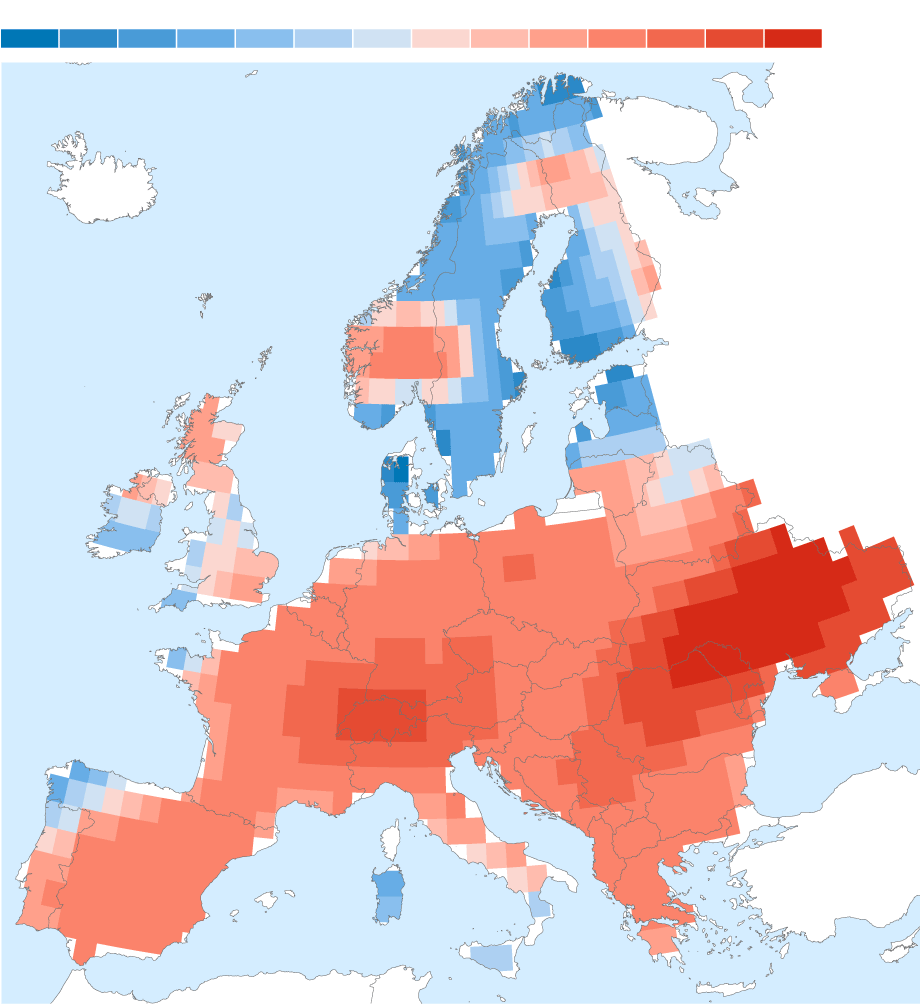
“This development is very worrying,” said Professor Claudia Hahn, lead author of the study. “The consequences will be felt not only by nature, but increasingly by us humans too.” The study found that most at risk are southern European countries such as Spain, Italy and Greece, but also warned that problems in traditionally water-rich regions such as parts of Germany and France will get worse as well.
The authors urge European governments to treat groundwater as a finite resource and to develop more robust water management systems. This includes reducing overuse, improving efficiency in agriculture, and increasing efforts to restore natural recharge areas such as wetlands and forests.
“We are seeing the result of decades of unsustainable water use,” said Blöschl. “The climate crisis is now making those practices untenable.”
Changes to the weather in Europe will be compounded by the collapse of the AMOC (Atlantic Meridional Overturning Circulation), otherwise known as the Gulf Stream that is expected in the coming decades. That will trigger a mini-ice age that will bring down temperatures in northern Europe by as much as 20°C.
Combined these two effects will drive populations from increasingly arid southern Europe and those from freezing northern climes into a narrow temperate band running across the centre of Europe.


