Japan revises second-quarter GDP growth up to annualised 1.4%
2 hours ago
A criminal court (sulh ceza) at the Caglayan courthouse in the European side of Istanbul on July 3 jailed popular stand-up comedian Deniz Goktas pending trial, according to local media reports.
As reported by IntelliNews on June 26, Goktas described Turkey’s president, Recep Tayyip Erdogan, as having transitioned from a "shy dictator" to one who is "at peace with himself" during his performance.
It is no joke
Following the hearing, Goktas was transferred to the Karatepe prison in the Corlu town of Tekirdag province, the western neighbour of Istanbul. It is a high-security prison, known as “well-type” since prisoners are kept alone in five square-metre cells and they have no access to direct sunlight.
The prisons in question were designed for those who were convicted for being a member of a terrorist organisation. Some special prisoners are also kept in these facilities for the sake of educating them.
On July 5, Gurkan Turkoglu, a prisoner who spent 266 days on hunger strike to demand to be transferred to a non-well-type prison, died.
The court ruling follows the widespread social media success of Goktas’ latest stand-up special, Ölü Deniz (Dead Sea). The performance, which has so far garnered more than 11mn views after being uploaded on YouTube on June 24, features a biting, satirical critique of Turkey’s current political landscape and societal pressures.
Well-planned political act
Legal proceedings were initiated after segments of the show were circulated on social media, prompting calls for censorship by the government’s media and trolls. As reported by IntelliNews on June 28, portions of the special posted on X (formerly Twitter) had been blocked from access in Turkey by a court order under the pretext of "national security".
On June 29, the Istanbul chief public prosecutor’s office announced that it had launched a prosecution against Goktas. In response, Goktas wrote on X that he was abroad for a vacation and he would be back. It was obvious that he would be jailed.
On July 2, Turkish police forces detained Goktas at Istanbul Airport during a passport control check upon his return to Turkey from a trip abroad.
The Goktas incident is not a mistake by the comedian or a slip of the tongue. It is rather a very well-planned and well-executed political act to remind people of the situation in Turkey. He was very well aware that he would end up in jail when he uploaded his video on YouTube.
Erdogan’s opinion on dictator discussion
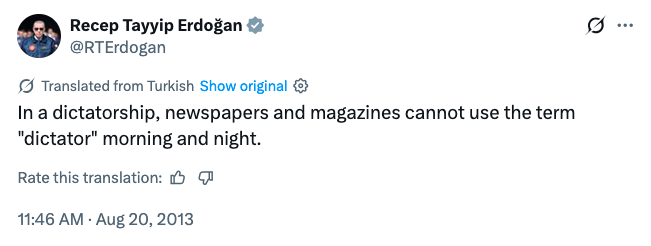
Tweet: President Recep Tayyip Erdogan (@RTErdogan) wrote in August 2013 during the widespread Gezi protests in Turkey: “Where there is a dictatorship, newspapers and magazines can not use the term dictator day and night.”
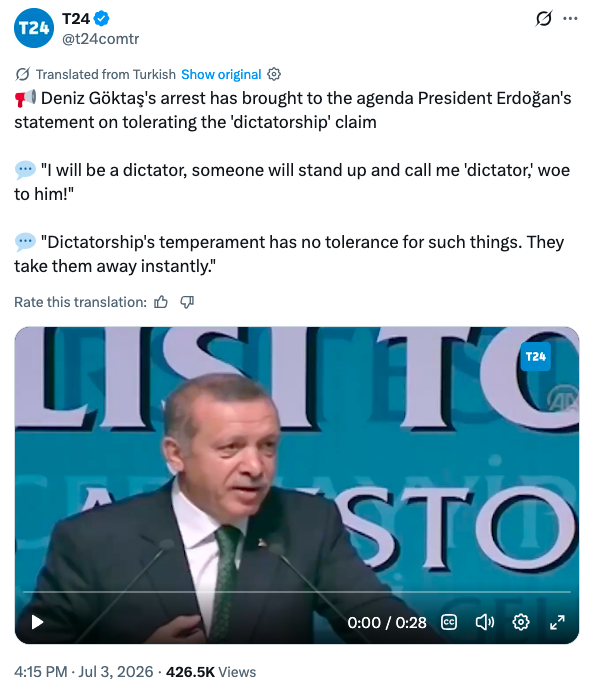
Screenshot: Back in 2013, Erdogan talking on a separate occasion on the dictator matter: “If I were a dictator and someone stood up and called me a 'dictator,' woe betide them! The nature of dictatorship does not tolerate such things. They would be taken away in an instant.”
The dictator discussion in Turkey is not new. It dates back to the countrywide Gezi protests that were held against Erdogan across the summer of 2013. Goktas is also pointing at a transition in the matter.
Back then, Erdogan’s argument was that no one would be allowed to call him a dictator if he was a dictator. His tweets and videos on the matter have been re-circulated with the Goktas incident.
Backed by the West, and the East
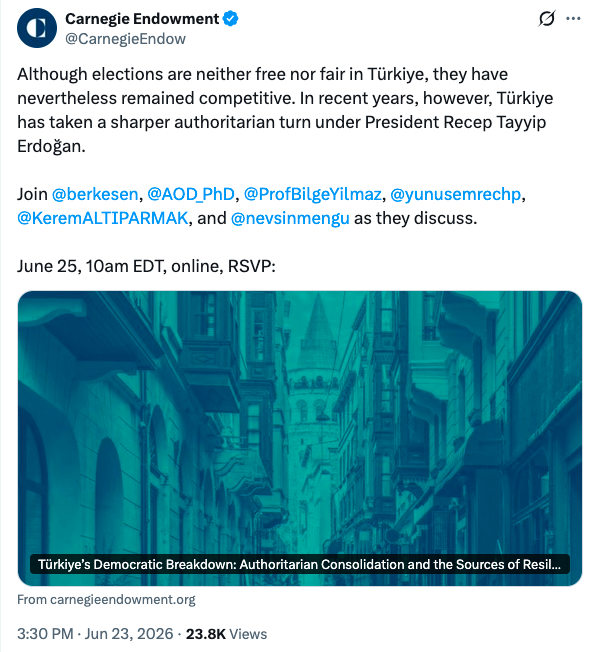
Tweet: Not free, not fair but competitive. The destiny of any attempt to legitimize Turkey’s government unfortunately is to fall into a fallacy. Where competitiveness is concerned, two of Erdogan’s rivals in presidential elections, namely Selahattin Demirtas and Ekrem Imamoglu, are currently in jail.
In recent weeks, access to the social media accounts of numerous LGBT+ organisations and activists has been blocked while more than 200 people have been detained ahead of next week's Nato leaders' summit in the capital Ankara, the BBC noted on July 3 while reporting the Goktas incident.
During July 7-8, all of the heads of state of Nato members will be in Ankara.
The Erdogan government is also backed by non-Nato actors in the league of states such as Russia, China and Iran.
Thanks to the global consensus in question on the continuation of the Erdogan government in Turkey, the lack of legitimacy at home makes no sense.
The IntelliNews PRO service includes access to reports, exclusive market data, and more news that decision-makers care about. Stay ahead of the market with IntelliNews PRO.
Sign Up Now