


Oil export price beats Azerbaijan's 2026 budget plan by 22% in Q1
4 hours ago
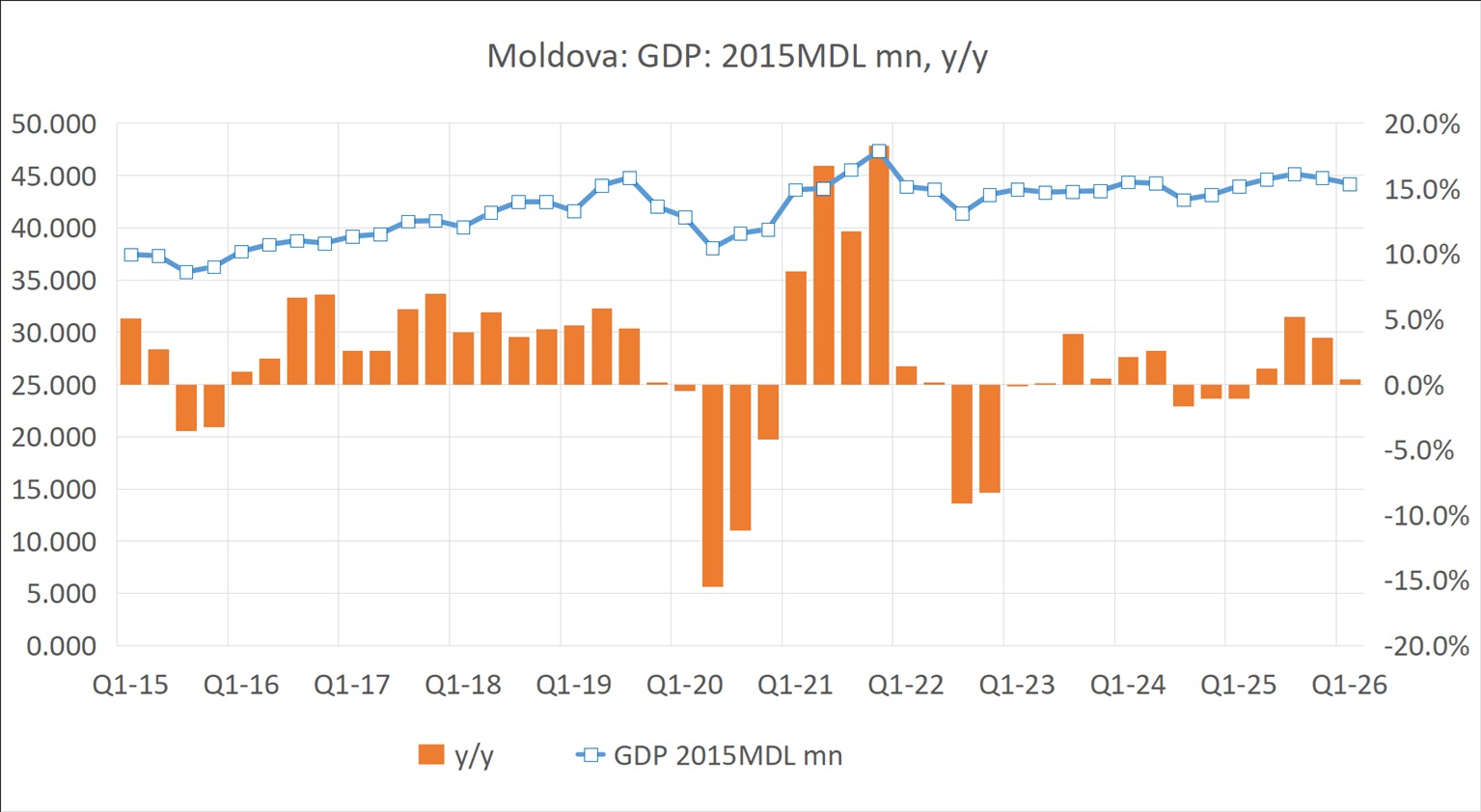
Moldova’s GDP (chart) increased by 0.4% y/y to MDL38.17bn (€3.86bn) in the first quarter of 2026, according to data published by the statistics bureau BNS. The annual growth rate slowed from 3.6% y/y in Q4 and 5.2% y/y in Q3 last year, as the domestic demand, particularly the gross fixed capital formation, lost momentum.
The country’s economy is expected to decelerate to 2% growth in 2026 from 2.4% in 2025, as the conflict in the Middle East and spillovers from Russia’s attacks on Ukrainian energy infrastructure weigh on activity, according to the European Commission’s Spring Forecast published on May 21.
In seasonally adjusted terms, GDP contracted by 1.2%, following a 0.8% decline in Q4, marking another episode of technical recession. In practice, Moldova’s economy has broadly stagnated over the past five years, as the country has had to absorb the effects of higher energy prices, switch from preferential but politically costly Russian gas supplies to market-based imports, replace low-cost electricity from Transnistria with more expensive imports from Romania and domestic generation, and cope with an increasingly difficult regional environment.
At the same time, Moldova has made progress in areas not fully captured by GDP figures and has formally launched accession negotiations with the European Union — a process expected to provide a stronger impetus to growth, particularly after the eventual resolution of the war in neighbouring Ukraine. The European Commission expects economic growth to accelerate to 3.5% in 2027, supported by investment related to EU integration.
The economic slowdown was driven by less dynamic domestic demand. Domestic consumption growth slowed to 1.5% y/y in Q1 from an average of 3.5% in 2025. Gross fixed capital formation contracted by 7% y/y, after expanding by 16.9% in 2025.
On the upside, net imports accounted for 23.5% of total domestic demand, down from 28.0% a year earlier, indicating a modest improvement in the country’s structural external imbalance. The deficit is financed largely by formal and informal remittances from Moldovans working abroad, mainly in Europe.
On the production side, manufacturing generated 6.1% more value added than a year earlier, contributing 0.5 percentage points to GDP growth. Wholesale trade added 0.4 percentage points with a 2.7% increase in value added, while utilities and transportation contributed 0.3 percentage points each, supported by growth rates of 13.4% and 6.6%, respectively.
By contrast, the IT and real estate sectors subtracted 0.7 percentage points each from GDP growth, following contractions of 8.1% y/y and 7.8% y/y, respectively.
Overall, total value added remained broadly unchanged from a year earlier, while a 2.7% increase in net tax collection accounted for the entire 0.4% expansion in GDP.
The IntelliNews PRO service includes access to reports, exclusive market data, and more news that decision-makers care about. Stay ahead of the market with IntelliNews PRO.
Sign Up Now


