_1.jpg)


_1787576584.jpg)
Turkey’s ‘agent’ in Somalia whips up fresh scandal with Northern Cyprus phone call
5 hours ago
The United States and Iran have agreed to end their war and reopen the Strait of Hormuz, Pakistan said, in a breakthrough that promises relief to a global economy battered by more than three months of conflict on June 14.
The agreement, due to be signed in Switzerland on June 19, largely restores the situation that existed before fighting broke out, but leaves Tehran with a potent new lever over the world economy through its proven ability to disrupt traffic through the strait, the conduit for a large share of seaborne oil, natural gas and fertiliser shipments whose effective closure rattled global markets.
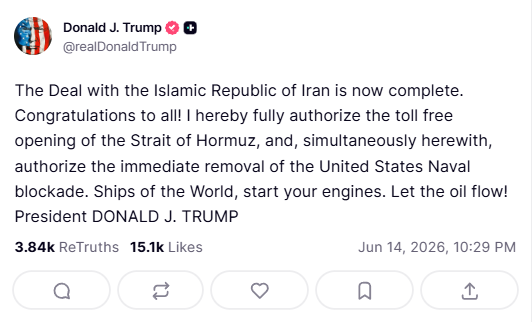
US President Donald Trump confirmed a deal had been reached and authorised an end to the US naval blockade of Iranian ports. "Ships of the World, start your engines. Let the oil flow!" he wrote on social-media platform Truth Social, adding that he had authorised the "toll free opening of the Strait of Hormuz" and the immediate removal of the blockade.
Pakistan, acting as mediator, said both sides had declared the immediate and permanent end of military operations on all fronts, including in Lebanon. It said mediators would facilitate meetings later in the week to lay the groundwork for technical talks.
Full terms were not immediately available, and it was unclear how quickly the strait would reopen to all traffic. Washington had previously said it would ease its blockade as the waterway reopened and relax sanctions to allow Iran to sell more oil.
The deal followed a day of strain after Israel, excluded from the talks, struck Beirut's southern suburbs.
The US and Israel launched the war on February 28 with strikes that killed Iran's supreme leader, Ayatollah Ali Khamenei. His son is now supreme leader and gave the approval needed for Tehran to sign, though he has not appeared in public since the war began. Iran retains its missile programme, support for regional proxies including Hezbollah in Lebanon and a stockpile of highly enriched uranium.
Iranian President Masoud Pezeshkian defended officials conducting negotiations and said his government considered itself responsible and accountable to the Iranian people in a series of social media posts, Borna News reported on June 14.
The remarks point to internal strain within Iran's establishment over the conduct of the war and negotiations with the United States, with the president seeking to shield officials and military personnel from domestic criticism as hardline factions press their own demands and mediators work to finalise a deal.
Writing on the social media platform X, Pezeshkian said it was regrettable that people acting within official mandates to safeguard national interests and the country's dignity were being attacked, calling such criticism unfair.
In a subsequent post, he said the government considered itself obliged to support forces defending the country and safeguarding the people's security. Fighters who had risked their lives to defend the homeland could not be expected to stand firm while their support, equipment and needs were ignored, he said.
Following the president, the top security official and secretary of Iran's Supreme National Security Council, Mohammad Bagher Zolghadr, warned that a response by what he called the fighters of Islam was coming and that violations of the Islamic Republic's red lines would not be tolerated, Iranian Students News Agency reported on June 14, citing Mehr.
The warning by one of Iran's most senior security officials adds to hardline pressure against any concession in negotiations with the United States, coming as mediators push to finalise a deal to end more than three months of war and as Tehran insists that fighting in Lebanon remain part of any settlement.
The deal also drew criticism from members of Iran's Assembly of Experts, who said the concept of a ceasefire was effectively meaningless and that the country remained in a state of war, in a statement setting out hardline red lines as negotiations with the United States moved towards a possible agreement, Iranian Students News Agency reported.
The 34 clerics said the measures, red lines and framework set by the supreme leader were the final word on the talks, and that any departure from those red lines would be illegitimate, unacceptable and met with a public response.
Citing what they called the enemy's hostile acts, including the naval blockade and Israeli attacks in Lebanon, the members said the situation remained one of war and that a ceasefire had no practical meaning. Countermeasures, particularly in response to the naval blockade, were necessary, they said.
The statement set out demands including the naming and punishment of the aggressor, the payment of reparations for damage caused, recognition of Iran's management of the Strait of Hormuz as a non-negotiable right and a refusal to discuss what it called the country's nuclear rights.


