


Moldova’s GDP growth eases to 0.4% y/y in Q1 on softer domestic demand
11 hours ago
Turkey’s five-year credit default swaps (CDS) have tumbled to the 220s, recording the lowest levels seen since late February. The change in the indicator is attributed to the global rally seen in markets on the back of expectations that the latest agreement between the US and Iran on ending the Middle East conflict will hold, according to media reports.
The positivity was also felt in bond prices and equities.
Across recent years, Turkey’s CDS have mainly moved in the 200 to 300 range with some spikes observed in tense periods triggered by domestic or international political developments.
The recent contraction in the country’s risk premium reflects a broader wave of optimism washing across emerging markets. Over the weekend, US President Donald Trump announced that the deal with Iran had been finalised, stating that he had authorised the immediate lifting of a US naval blockade and the reopening of the Strait of Hormuz.
As a result, crude oil prices retreated sharply. Prior to February 28, when the US and Israel launched the attack on Iran that triggered the new phase of conflict, Brent oil prices were hovering in the $60s. Following the announcement of the deal by Trump, the $70s hit traders' screens for the first time since the latest hostilities began.
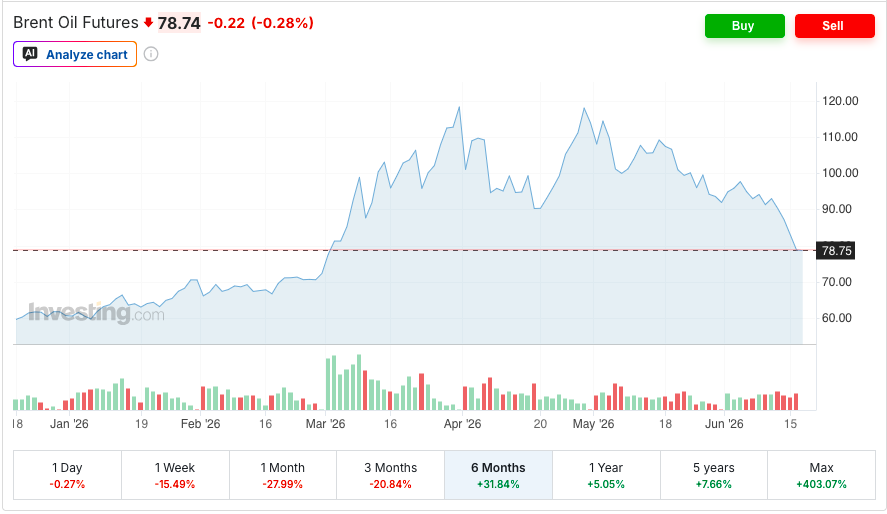
Chart: The Brent oil price fell below the $80-level for the first time since the beginning of March.
On May 14, Turkey’s central bank raised its average Brent oil price forecast for 2026 to $89 from the $60s per barrel provided in the February report.
With the fall in Brent prices, a revival of Turkey's rate-cutting cycle re-emerged as a possibility. On July 23, the central bank will hold its fifth rate-setting meeting of the year.
According to international media reports, the US/Iran deal is actually another attempt at a ceasefire. It includes clauses that open the way to negotiations in the following 30-day and 60-day periods. Israel, meanwhile, has not signalled that it will comply with an absolute ceasefire.
Iran, which still has proxies in Lebanon and Gaza, remains a clear threat to Israel in the Middle East. Without entirely eliminating the Iranian threat, or, in other words, securing a compliant government in Iran that would sign the so-called Abraham Accords and thus recognise Israel as a sovereign state, the Israelis will not be in a position that would allow them to bring the Iran War to an absolute end.
Israel is set to hold legislative elections by October 27. The ballot box results will certainly have an impact on the course of the conflict. A more moderate government may extend the truce period prior to the next phase of clashes. The current government looks minded to seek more clashes before the elections, with the promise of more afterwards, should it be re-elected.
Players in the financial industry love volatility. The Iran conflict will keep providing it.
The IntelliNews PRO service includes access to reports, exclusive market data, and more news that decision-makers care about. Stay ahead of the market with IntelliNews PRO.
Sign Up Now


