


Hungarian construction giant files for bankruptcy protection after state pulls out of €870mn office deal
6 hours ago
After two days of intense talks in Berlin, it’s decision time for Ukrainian President Volodymyr Zelenskiy. He has been given a set of options dealing with the two key questions of giving up territory to Russia and receiving security guarantees in return from his Western allies, but none of the options are perfect and the offers will expire very soon if he doesn’t choose.
At this point it appears that the Berlin talks will fail, leaving Ukraine in a limbo of destruction and death until a military defeat that could come in the spring of next year. Despite making a lot of progress, the two sides have reached an impasse that can’t be resolved:
Trump’s envoys were acting as a proxy for Russian President Vladimir Putin after spending more than a month drafting a 28-point peace plan (28PPP), that was slightly modified to a 27-point peace plan (27PPP) at the Moscow meeting on December 3 that changed little from the original Witkoff-Dmitriev plan, named after its authors, US Special Envoy to the Middle East Steve Witkoff and the head of Russia’s sovereign wealth fund, Kirill Dmitriev. That deal comes with a list of unpleasant demands but focuses on one: give up control of the Donbas region, commit to never joining Nato, and capping the size of the Armed Forces of Ukraine (AFU).
Europe countered with the E3-Ukraine 20-point peace deal (20PPP) on December 11, which is much more agreeable to Bankova, but has largely been rejected by the Kremlin as it contains many points that are red lines to the Kremlin, including keeping the door to Nato membership open and European peacekeepers on Ukrainian soil.
Witkoff and his colleague Trump’s son-in-law Jared Kushner have spent the time in between trying to find some middle ground, with limited success. As the Berlin meeting winds up, Trump said “great progress” has been made and a US official told Politico that 90% of the points were settled, but the question of security guarantees and land remain sticking points.
Trump told reporters in the Oval Office on December 15 that a deal is “closer than ever” and that he had “very long and very good talks” with Ukrainian President Volodymyr Zelenskiy and the leaders of France, Germany, the United Kingdom and Nato, but that significant hurdles remain.
“We’re having tremendous support from European leaders. They want to get it [the war] ended also,” Trump said. “We had numerous conversations with President [Vladimir] Putin of Russia, and I think we’re closer now than we have been, ever, and we’ll see what we can do.”
Zelenskiy confirmed that negotiations with US and European leaders were difficult but “productive.”
Security guarantees:
Ukraine needs security guarantees to ensure its sovereignty after the war ends. Without strong reassurances from its Nato allies, Russia will be free to mass troops on its border at any time and bully Kyiv over any contentious issue.
The US has offered Ukraine an unprecedented, but limited, Article 5-like security deal that includes a commitment to military aid should Russia re-invade.
"But it comes with a hidden ultimatum: accept it now, or the next option will be less generous," Politico reported, citing an unnamed US official involved in the talks.
The deal would only last for a decade, with an option to extend, and the aid would not be automatic.
"These guarantees won't be in effect forever. They will be in effect right now, if a positive outcome is achieved,” the source added.
Even with these limits, the offer is far stronger than any previous deal and a real commitment by the White House to securing Ukraine’s borders after a ceasefire.
Europe continues to vacillate on the question of security deals and is very reluctant to make a collective security agreement that includes a real military commitment to come to Ukraine’s aid should the war restart. Italy’s Prime Minister Giorgia Meloni has called for real Article 5-like agreements since the White House summit on August 18, but few of her peers are willing to go that far and are suggesting more “security assurances” that do not include a military collective security component.
Germany was case in point with a new 10-point assurances list that does little more than to beef up liaison between Berlin and Kyiv and more investment in Ukraine’s defence sector.
In a joint statement with German president Frank-Walter Steinmeier, Zelenskiy said: "A strong Ukrainian defence industry is crucial for defence against russia's [sic] war of aggression and is an important element of security guarantees to deter future russian [sic] aggression." Bankova has taken to trolling Russia by refusing to capitalize the country's name in non-formal communications.
In earlier comments, Russia hawk, EU foreign policy chief and former Estonian Prime Minister, Kaja Kallas, outlined similar plans for the EU as a whole, pointedly omitting any talk of a military collective security deal.
Following a dinner in Berlin at the end of the talks, attended by most of the top EU leaders as well as the US delegation, European Commission President Ursula von der Leyen and Nato General Secretary Mark Rutte, they issued a joint statement that promised continued support for Ukraine, but pointedly failed to mention any collective military commitments – in other words another security assurance, and not a security guarantee.
The points listed in the statement were:
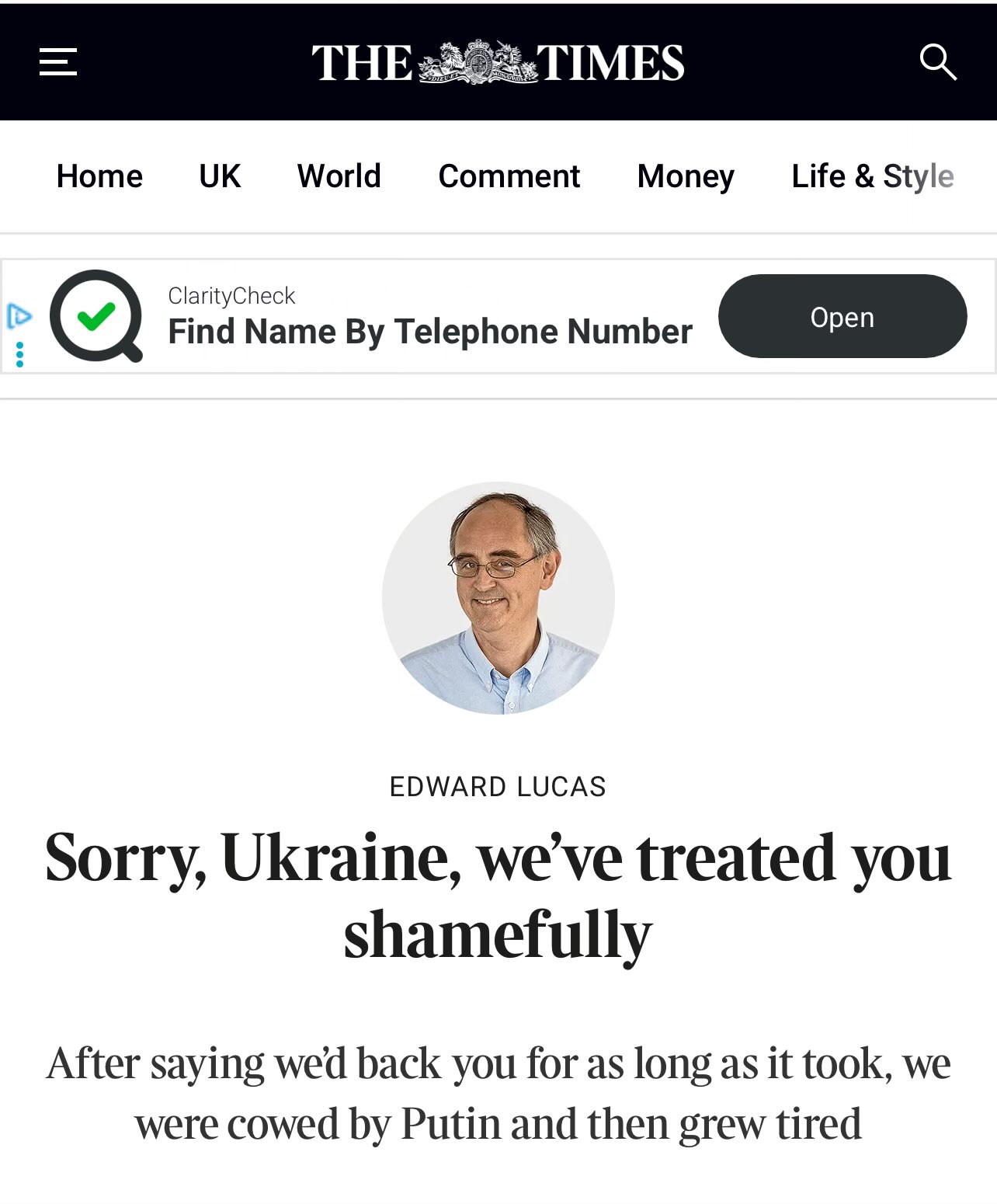
Europe’s half-hearted support has made Ukraine’s supporters increasingly pessimistic about the prospects of the war. As bne IntelliNews reported, the international press coverage of the conflict has become increasingly negative as it becomes clear Bankova has been left in an impossible situation. In the latest opinion piece, veteran Russia reporter Edward Lucas headlined a comment with: “Sorry, Ukraine, we’ve treated you shamefully,” with the strapline: “After saying we’d back you for as long as it took, we were cowed by Putin and then grew tired.”
Politico ran a similar piece reporting that a split has appeared in Europe with the Germans and French calling for less spending on Ukraine, while in the US, the UK and Canada, respondents called for current levels of spending to be maintained.
Land:
The negotiations have become stuck on the small part of the Donetsk region in the Donbas that Russia still does not control. As bne IntelliNews reported, the Armed Forces of Russia (AFR) has already completed the capture of Lugansk in July, but around 15% of neighbouring Donetsk remains under AFU control and is well protected by the Fortress Line of defences. Putin is insisting that the AFU quit Donetsk completely. Bankova is refusing.
Kyiv wants a ceasefire that freezes the forces along the current line of contact and is operating on the principle, “standing where we stand”, which Bankova regards as “just.” A constant rhetorical refrain in the peace talks has been Bankova is seeking a “just peace,” which has also always implied it is willing to make some territorial concessions.
Zelenskiy said that Bankova will not give up the Donbas either de jure or de facto on December 15, nixing the compromises of creating a free economic zone in the region of a mooted Korean DMZ-model that have both been floated by the White House as alternatives in the last week.
"Neither de jure nor de facto will we recognize Donbas as Russian, the part that is temporarily occupied. But, nevertheless, we will discuss the issue of territory. You know that it is one of the key ones, we do not yet have a consensus on this issue,” Zelenskiy said Interfax reports.
Giving up land is banned by the constitution. In a compromise, Zelenskiy revived the idea of holding a referendum to give him the necessary authority en route to Berlin. However, after the meeting was concluded he said: “We are not talking about a referendum yet," suggesting that the two sides are still far from agreeing on this question.
The problem for Ukraine is that beyond Donetsk the land is open and flat all the way to Dnipro River that cuts the country in two and there are no major cities or towns, making that territory very hard to defend should the AFR launch an assault.
As for the other two occupied regions of Kherson and Zaporizhzhia, the Kremlin has offered to freeze the fighting along the current line of contact. Control of the Zaporizhzhia nuclear power plant (ZNPP), the largest in Europe, remains in dispute.
Domestic agenda
Giving land away will be extremely hard and creates a domestic political problem for Zelenskiy. A poll released on December 15 found that 75% of Ukrainians said a deal conceding land to Russia or capping the military was "completely unacceptable", according to Kyiv International Institute of Sociology (KIIS). But 72% of Ukrainians were prepared for a deal that froze the current front line and contained some compromises. Sixty-three% of Ukrainians were ready to continue fighting, and just 9% believed the war would end by early 2026, reports Reuters.
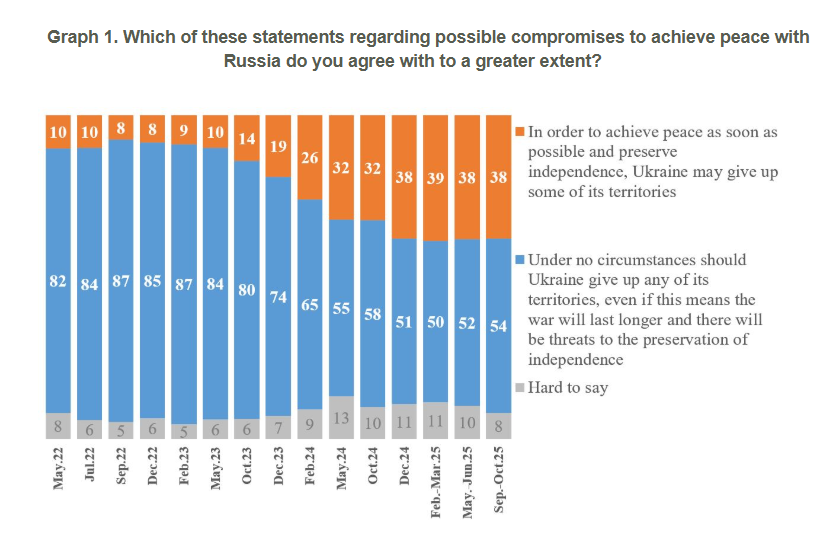
Trump has claimed that 82% of Ukraine want a peace deal – a statistic he appears to have made up. The KIIS poll suggests that the opposition to giving up territory has hardened amongst ordinary Ukrainians in the last two months: another poll from the autumn found that 54% are opposed to giving up land to achieve peace, while 38% agree.
This creates a domestic political problem for Zelenskiy and is maybe contributing to his reluctance to give away the Donbas. Another point in the 27PPP is the US are calling for a new presidential election within 100 days of any ceasefire deal.
Zelenskiy repeated on December 15 that he was willing to call elections, if security could be provided for the poll, but his own political career will be on the line. Zelenskiy currently trailing in the polls against the former commander in chief and current ambassador to the UK, General Valerii Zaluzhnyi. His popularity has also been dragged down by the expanding Energoatom corruption scandal, where his close personal friends ran a $100mn kickback scam and then fled the country.
The polls motivate Zelenskiy to refuse to give up the Donbas to Russia but leave him room to freeze the conflict along the line of contact.
Time running out:
The time to make a deal is running out. Trump has made it clear he wants a deal by Christmas or he will walk away, taking what little military aid and intelligence the US is still sharing with Ukraine with him.
Putin has limited patience as well. The AFR is making the most rapid gains it has made since the start of the war and taken an additional 500 square kilometres in just the last two months, according to military analysts. The battle for Pokrovsk is all but won, a key logistical hub that supports the entire eastern front, and the AFR are well manned and well supplied according to the latest battlefield reports.
By contrast the AFU is in a state of collapse. Outnumbered by ten-to-one according to some reports, kilometre-long holes have appeared in the defensive lines due to chronic manpower shortage. The desertion rate has soared with circa 116,000 cases against soldiers that have gone AWOL open, although the real number of absconded soldiers is thought to be twice as high – equivalent to about a third of the total Ukrainian fighting force.
While Ukraine is well supplied with domestically manufactured drones – a vital resource that allows the AFU to hold Russian advances at bay – it lacks everything else, especially air defence system and ammo, and enough powerful long-range missiles to take the fight across the board and hit vital Russian energy and logistical infrastructure.
Putin is fully engaged in negotiations for the time being, using the US envoys as a proxy to negotiate with Zelenskiy for the first time. However, like Trump he also made it clear that an agreement is not reached quickly he will drop the talks and focus on a military victory that could come as soon as next spring, thanks to Kyiv’s mounting lack of money problems.
The Kremlin is more motivated to do a deal than first appears. For Putin, Trump is a once-in-a-lifetime opportunity to prevent Ukraine from ever joining Nato – Putin’s overriding security concern – and force it to return to the neutrality that was enshrined in its constitution since the country was founded in 1994 until Nato membership was made a national ambition by the Poroshenko administration in 2014. Ironically, the idea of joining Nato – seen as a nemesis since Soviet times – was not popular amongst Ukrainians until the war with Russia began.
The IntelliNews PRO service includes access to reports, exclusive market data, and more news that decision-makers care about. Stay ahead of the market with IntelliNews PRO.
Sign Up Now


