


Bank of Japan lifts rates 25 basis points to 31-year high
1 hour ago
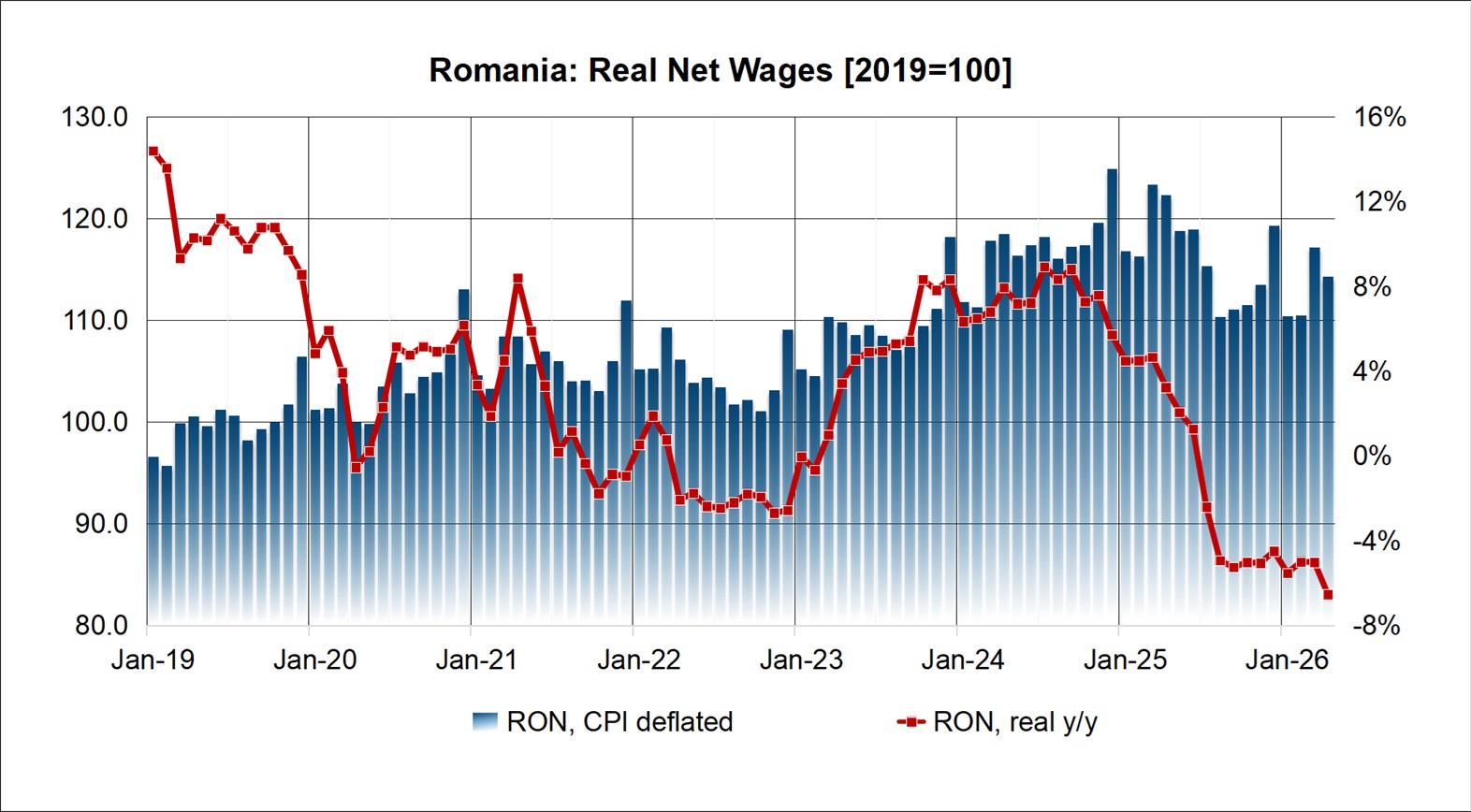
The average net wage in Romania (chart) increased by 3.5% y/y to RON5,843 (€1,117) in April, insufficient to keep pace with consumer prices, which rose three times faster (+10.7% y/y), according to data published by the statistics office INS. As a result, the average net wage contracted by 6.5% in real terms, the steepest decline in the past decade.
In public administration and education, where wages are predominantly financed from the general government budget, real average earnings fell by more than 13% y/y, twice the pace of the economy-wide average decline. In healthcare and social assistance, where a significant private sector has emerged, real average net wages contracted by only 9.2% y/y.
In all these predominantly public sectors, wages remain close to the national average, standing above average in public administration and below average in healthcare. The need for thorough reorganisation of the incomes in the budgetary sector under an imminent Wage Law is complicated by budgetary constraints, making structural reforms essential.
In the core manufacturing industries, average net wages declined by a more moderate 4.4% y/y in real terms. Some sectors even recorded positive performances, notably tobacco processing, where wages increased by 15% y/y in real terms and are already more than twice the economy-wide average. The highest earnings continue to be paid in information technology and specialised financial services, including insurance and pension funds, where average wages also exceed twice the national average.
From a broader perspective, however, the sharp erosion in real incomes seen since last July is partly correcting what had become an unsustainable wage expansion in 2024. Compared with April 2023, the average net wage in Romania remained 4.1% higher in real terms in April 2026. While modest, this increase is broadly in line with the sluggish pace of economic growth recorded over the past three years.
Moreover, the dynamics of average wages may conceal diverging trends across income groups. There is no high-frequency income per decile or quartile data reported by the statistics office, INS. Higher-income employees are likely to have been better positioned to absorb the recent adjustment, while the combined effects of income correction and elevated inflation have probably had a more pronounced impact on lower-income households.
The IntelliNews PRO service includes access to reports, exclusive market data, and more news that decision-makers care about. Stay ahead of the market with IntelliNews PRO.
Sign Up Now


