
_0_1780930643.jpg)


Quarrel in Turkey as prosecutors go after 95-year-old Rahmi Koc for derogatory joke
2 hours ago
US President Donald Trump has demanded NATO allies and China send their warships to aid the US in reopening the Straits of Hormuz. Most have refused.
Trump said in a social media post his administration has already contacted seven countries, but did not identify the countries. In a weekend social media post he "hoped" China, France, Japan, South Korea, Britain would participate, Reuters reported.
Trump has sent a blunt message to European nations to join his war effort in Iran and help open up the Strait of Hormuz. “If there’s no response or if it’s a negative response I think it will be very bad for the future of Nato,” he told the Financial Times in an interview on March 15.
The US has been caught napping and has no plan to counter the closure that is causing chaos. The Economist reported last week that if the straits stay close for only another two weeks, oil will hit $200 per barrel. As bne IntelliNews reported, the Gulf producers are running out of storage space and once their tanks are full they will have shut down production which will rock the market. Once production is off, it is not simple to restart it.
In the last few weeks it's transpired that the Trump administration had no plan to deal with the closure of the Straits of Hormuz. When asked by a journalist what led Trump to order the attack, a decision that was made by his inner circle and did not include consolations with either the Pentagon or the State Department, according to reports, spokeswoman Karoline Leavitt said “he had a feeling” that Iran was about to attack the US.
Trump is casting around for solutions. Almost the entire US naval power is currently under steam on its way to the gulf also at the same time trump has reached out to his allies to send additional battleships into the straits go to start and it appears the White House is considering launching a ground invasion to capture the coastline, particularly the Qeshm Island that commands both the straits and the coast. As bne IntelliNews’ military analysts reported, attempting to land US troops in the Straits of Hormuz and capture the islands and coastline would be extremely hazardous, and likely end in heavy casualties amongst the US forces.
Trump claimed any danger to allies moving assets into the Gulf would be “minimal” since the US and Israel had destroyed Iran’s military capacity. However, the US navy continues to refuse requests from commercial shipping companies for an escort as the Straits remains “too dangerous to traverse.”
As the bulk of the US navy steams towards the Gulf, the two flag ships have retreated out of harm’s way. Both US carriers USS Abraham Lincoln and USS Gerald R Ford and are now over 1,000 km away from the area of engagement. As bne IntelliNews reported, the two ships are so expensive that thanks to Iran’s cost-to-kill ratio advantage, the US command cannot risk putting them in harm’s way and in range of Iran’s low cost drone and missile barrages.
Trump calls on China for assistance
Unexpectedly he also called on Beijing to send part of this powerful Navy to help to open the straits. Trump warns that his summit with Chinese President Xi Jinping slated to happen later this month may be delayed if Beijing refuses. The demand puts China in a bind: if it refuses it will be labeled by Washington as a free-loader; if it accepts it will lose it status with Tehran as “friendly country” to which oil is still be delivered under the informal permits-for-passage scheme allowing some tankers to pass through the Straits.
“It’s only appropriate that people who are the beneficiaries of the Strait will help to make sure that nothing bad happens there,” Trump said, arguing that Europe and China are heavily dependent on oil from the Gulf, unlike the US, which is self-sufficient.
“I think China should help too because China gets 90% of its oil from the Straits [sic],” Trump said. Trump confused his supply numbers: China buys 90% of the oil Iran produces, but that accounts for 20–25% of China's crude oil imports.
Trump calls on Nato allies for assistance
Trump also implicitly threatened to withdraw US cooperation with NATO even further. At the last NATO summit in The Hague and in the new and the Trump administration demanded that European NATO allies increase spending from 2% of GDP to 5% of GDP, and in the new National Security Strategy (NSS) Trump partly closed the US security umbrella by saying Russia was “Europe’s problem.”
“If there’s no response or if it’s a negative response, I think it will be very bad for the future of Nato,” he added.
The threat comes at a time when Europe has taken over the burden of supplying Ukraine with weapons it buys from the States, as stocks in Kyiv run dangerously low and American stockpiles are rapidly dwindling thanks to the conflict in Iran.
“We have a thing called Nato,” said Trump, who has often criticised the alliance. “We’ve been very sweet. We didn’t have to help them with Ukraine. Ukraine is thousands of miles away from us . . . But we helped them. Now we’ll see if they help us. Because I’ve long said that we’ll be there for them but they won’t be there for us. And I’m not sure that they’d be there.”
Japan, Australia refuse to participate
Trump's call for aid fell on deaf ears in Oceania with both Japan and Australia declining to send naval vessels to the middle east.
"We know how incredibly important that is, but that's not something that we've been asked or that we're contributing to," Catherine King, a member of Prime Minister Anthony Albanese's cabinet, said in an interview with state broadcaster ABC.
Japanese Prime Minister Sanae Takaichi said that the “bar was very high” for Tokyo to commit warships. Japan is constrained by its constitution, imposed on it by US occupying forces at the end of WWII, that precludes military aggression of any kind. However, a ruling party policy chief Takayuki Kobayashi told public broadcaster NHK suggested that it could be done legally.
“While it is not legally ruled out, given the ongoing conflict, it is something that should be judged carefully,” ruling Liberal Democratic Party policy chief Takayuki Kobayashi told public broadcaster NHK. "We have not made any decisions whatsoever about dispatching escort ships. We are continuing to examine what Japan can do independently and what can be done within the legal framework."
Takaichi did confirm on March 15 that Tokyo would release oil from its strategic reserves, the third largest in the world, to alleviate pressure on oil prices. Japan is heavily dependent on the Gulf, which accounts for some 95% of its supply.
"I’m demanding that these countries come in and protect their own territory because it is their territory," Trump told reporters aboard Air Force One on the way from Florida to Washington. "It’s the place from which they get their energy."
US bring reinforcements to the Middle East
The US is bringing its full naval forces to bear on the Iran conflict. In the last days the Pentagon has ordered almost the full array of naval vessels not already in the Gulf to the theatre as fast as possible.
Several of the ships are troop carriers that bring several thousand soldiers from bases in places like Japan in a move that suggests a land invasion is now on the cards. The US standard military tactic is “shock and awe” where it brings overwhelming force to the start of a new war. This operation goes beyond that as the US is currently deploying almost its entire military might to bring Operation Epic Fury to an early end.
Among the latest reinforcements is the USS Tripoli, an America-class amphibious assault ship that has departed its forward base in Sasebo, Japan, carrying the 31st Marine Expeditionary Unit. The vessel, which displaces about 45,000 tonnes, is expected to reach the Middle East within one to two weeks, according to a US defence official cited by Fox News. The Wall Street Journal reported that the deployment was requested by US Central Command and approved by defence secretary Pete Hegseth.
The ship is carrying about 2,500 Marines as well as a mix of aircraft including up to 20 F-35B stealth fighters capable of vertical landings, MV-22 Ospreys, CH-53K heavy-lift helicopters and AH-1Z attack helicopters. The Marine Expeditionary Unit also includes infantry, reconnaissance, engineering and explosive ordnance disposal teams, giving it the ability to conduct amphibious assaults, rapid deployments and specialised missions.
Amphibious assault ships such as the Tripoli serve a different role from aircraft carriers. While carriers focus on launching fixed-wing air power and defending naval formations, amphibious ships are designed to deploy Marines and conduct operations close to shore. In a surge configuration the vessel can operate as a so-called “Lightning Carrier”, launching F-35B stealth fighters capable of short take-offs and vertical landings from its flight deck.
The aircraft can conduct air superiority missions, suppress enemy air defences and launch anti-ship strikes using long-range missiles. But defence analysts say the presence of Marines aboard the ship signals preparation for a broader range of contingencies, including securing maritime routes, mine-clearance operations and special forces support missions.
The additional deployments suggest the Pentagon is positioning forces capable not only of sustained air operations but also rapid amphibious and ground responses. Due to Iranian missiles and drones stationed on the coast, at this point the only way that the US can reopen the straits is if they occupy and control the coastline, experts say. However, a potential invasion raises many questions.
The potential ground force of 2,500 is too few to be able to capture and control the islands and the coastline on the northern side of the streets. When they arrive in around 2 weeks time.
The problem is that Middle East Force commanders gamed this out 40 years ago and estimated we'd need 6,000 Marines plus all equipment spread across multiple Islands. The plan was to first take Larak, Hormuz and Qeshem to box in Bandar Abbas. Then small landing parties to raid, Greater/Lesser Tumb, Abu Musa, Sirri, and then Kish, according to Malcom Nance, a former US intelligence officer and military analyst.
“Hundreds of thousands of IRGC troops and Basij regular army would come out and bombard/suicide attack these islands from the mountains that hover over them,” says Nance.
Another problem with the ground-based assault is that it would have to be resupplied from US bases in the UAE and Qatar which would provoke a heavy response by Iranian missile strikes to cut them off. The US’ regional allies are already unhappy with being targeted for hosting US bases, and analysts say it's entirely possible they will refuse to cooperate.
Even the landing of the troops would be difficult. They would come under fire from shaheed drones from the air and unmanned naval drones from the sea, the fleet of mini-submarine and another fleet of fast boats. In addition, Iran could lay its naval mines in the approaches in the run up to an invasion. The attempt to land in Straits of Hormuz could play out along similar lines to the Allies Normandy landings in the Second World War, says Nance.
“I have absolutely no idea how anyone could seize more than 2,000 km of Iranian coastline to secure the strait and capture Kharg island,” says bne IntelliNews’ military analyst Patricia Marins. “How exactly would that even work if the Iranian navy is still fully operational with hundreds of missile launchers and at least 20 submarines? What kind of force is supposed to establish positions at the foot of the mountains that cover almost the entire Iranian coast? No force would survive there."
"I agree that the only way to achieve any objective would be with boots on the ground, but I still don’t see the slightest chance of that happening," Marins adds. "If they actually try it, it will be a massacre, and I believe White House might genuinely be thinking about doing it."
Kharg island gambit
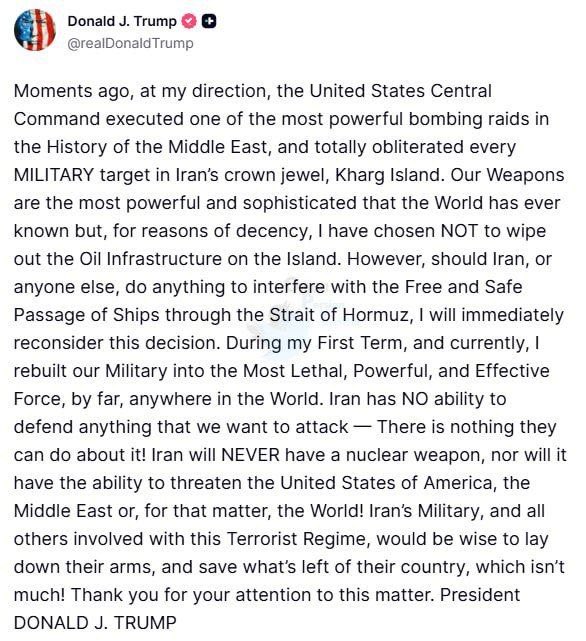
“OK, I suppose we should admit the White House was right, and, all along, they did have a plan to deal with the closure of the Strait of Hormuz. Bomb Kharg Island,” Bloomberg commodities commentator Javier Blas said in a sarcastic post on social media.
Trump, by referencing attacks on military facilities in the Khark Island and threatening to destroy its oil capacity, has attempted to create a new equation pitting "Khark Island" against the "Strait of Hormuz."
“This threat is unlikely to evolve into a credible equation. Tehran views the Strait of Hormuz as its most vital geopolitical lever and has committed all its resources to maintaining control over this crucial passage, which is also one of the key elements for successfully exiting any conflict. Iran will not back down on this,” says Mostafa Najafi, a Middle East analyst.
The IntelliNews PRO service includes access to reports, exclusive market data, and more news that decision-makers care about. Stay ahead of the market with IntelliNews PRO.
Sign Up Now

_0_1780931295.jpg)

