


Is Netanyahu's attack on Syria part of his greater election strategy?
15 hours ago
China and the EU have crossed the threshold beyond which population decline is mathematically irreversible — no matter what fertility policy is adopted. Now they simply don’t have enough women of childbearing age to produce enough children to keep the population stable, irrespective of what happens to the fertility rates.
There is a demographic tipping point that receives far less attention than the fertility rate: when the median age of a country's female population rises above approximately 40, the cohort of women in their prime childbearing years (20-35) becomes so small, relative to the total population, that even a miraculous return to replacement-level fertility of 2.1 children per woman cannot prevent absolute population decline for generations.
The age structure itself has become the constraint. China and most of the European Union countries have already crossed that line.
As IntelliNews reported, a global demographic crisis is accelerating. Three-quarters of the planet's countries will, by 2050, no longer be producing enough children to replace themselves.
Populations everywhere, with the notable exception of Africa and Central Asia, will see their populations fall dramatically, causing widespread economic and pension funding problems. Amongst the BRICS, China’s population is expected to halve to 600mn. The only country that will more or less hold its own is India. All of Europe is afflicted as no country is anywhere close to replacement rate fertility. And Ukraine has the worst demographics in the world.
By 2100, according to the projections of the Institute for Health Metrics and Evaluation at the University of Washington, that figure rises to 97% of countries, including India and the majority of burgeoning Africa.
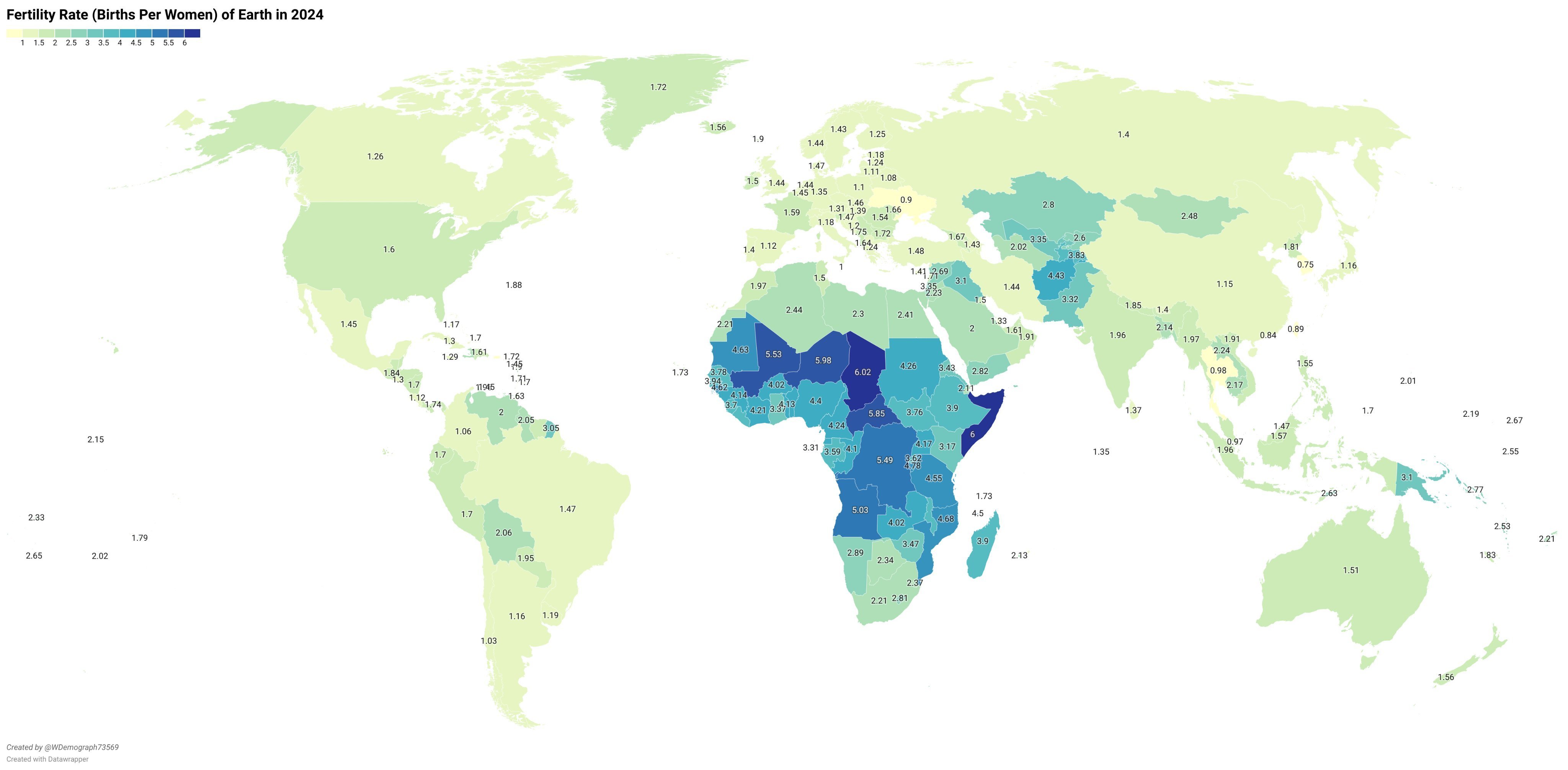
Female median age rising to the point of no return
China's median age was 39.1 in 2023 and has since risen toward 40 — but the median female age is already above that threshold given women's longer life expectancy. China's fertility rate stands at 0.93 children per woman, the lowest of any large economy. It needs to be 2.1 to keep the population constant.
The consequence is brutal in its arithmetic: even if China's fertility rate magically returned to replacement level tomorrow, the country would still lose more than 40% of its population by 2100, because the mothers required to produce the next generation are already a shrinking minority. China's population is projected to fall from its 2022 peak of 1.4bn to well below one billion — possibly as low as 800mn — by the end of the century. "It's almost impossible to reverse a demographic decline," said Louise Loo, head of Asia economics at Oxford Economics.
By 2100, populations in some major economies will fall by 20 to 50%, based on UN projections. Age structures are inverting — from pyramids to obelisks — as the number of older people grows and the number of younger people shrinks, Nature reports.
The EU's situation is particularly bad. Europe is already the world's oldest region overall, with an average median age of around 43 years. Some regions of Germany and Italy already have median ages above 50. Oxford Economics expects the working-age population of the eurozone to start shrinking next year.
The United States sits at the borderline — its overall median age of 39.5 keeps it marginally clear of the tipping zone for now, but its fertility rate of 1.6 means that without sustained immigration, it will cross the threshold within a decade. India remains the world's most significant demographic outlier among large economies, with a median age of around 29 and a fertility rate near replacement at 2.0 — the one major economy still on the right side of the line.
The policy implication is sobering. Faced with what is becoming an unsolvable problem, governments are debating pro-natalist policies — cash bonuses for babies, parental leave, housing subsidies — that may be largely irrelevant for countries that have already crossed the 40-year-old-women threshold. These policies can slow the decline but they can’t stop it. The population that will be alive in 2070 has already been born, or will never be born at all.
The table below shows where the world's major economies stand against the approximate 40-year median female age threshold. Median female age estimated at approximately 2-3 years above overall median, reflecting female longevity advantage.
| Country | Overall Median Age | Est. Median Female Age | Fertility Rate | Below Tipping Point? |
| Japan | 50 | ~53 | 1,13 | Yes — deep |
| Italy | 48,4 | ~51 | 1,2 | Yes — deep |
| Germany | 46,8 | ~49 | 1,3 | Yes |
| Spain | 46,8 | ~49 | 1,19 | Yes |
| South Korea | 45,5 | ~48 | 0,8 | Yes — extreme |
| EU average | ~44 | ~46 | 1,46 | Yes |
| China | ~40 | ~42 | 0,93 | Yes — at threshold |
| France | 42 | ~44 | 1,56 | Yes |
| United States | 39,5 | ~41 | 1,6 | Borderline |
| India | ~29 | ~30 | 2 | No |
|
Source: UN World Population Prospects, CIA World Factbook, Eurostat 2025. Median female age estimated ~2-3 years above overall median (female longevity advantage).
|
||||
The IntelliNews PRO service includes access to reports, exclusive market data, and more news that decision-makers care about. Stay ahead of the market with IntelliNews PRO.
Sign Up Now


