
_0_1780930643.jpg)

Ukraine’s energy future hinges on reform as war damage tops $88bn - KSE
28 minutes ago
The war in Iran is quickly showing it’s not about firing more sophisticated weapons at your enemy. It’s about the “Command of the Reload:” being able to reload with the same weapons and keep firing.
The US and ISrael fired 5,197 munitions in the first 96 hours of the war, which makes Operation Epic Fury the most intensive opening campaign in modern history. It dwarfs the initial three days of the UN-approved “No Fly Zone” intervention in Libya, which saw approximately 735 bombs and missiles used, with about 20,000 munitions expended in total between March and October of 2011.
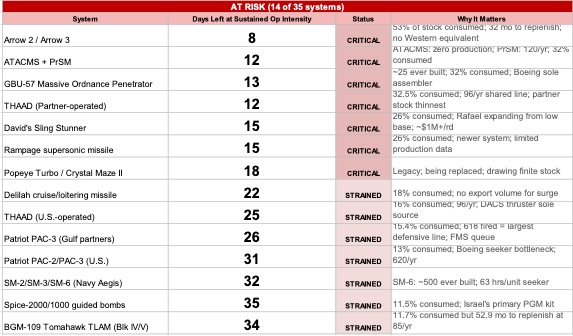
A study by the Foreign Policy Research Institute (FPRI) found that of the 35 munitions fired by the US and Israeli forces in the first 96 hours of Operation Epic Fury, 14 systems are now already critically strained and all of those are amongst the most sophisticated that provide things like air defence and the most difficult to replace.
As bne IntelliNews reported, the US massively outguns the Iranian Revolutionary Guard Corps (IRGC) that is leading the defence, but is at a considerable disadvantage on the cost-to-kill ratio: Iran can simply run down US and Israeli sophisticated defences by firing a mass of cheap and “good enough” munitions in the hope that at least one will get through. The Pentagon has admitted that a single missile or high speed drone boat could sink one its multi-billion-dollar battleships if it get through. The FPRI report, and other analysts, have come to the same conclusion.
American military strategy is undergoing a structural shift as modern warfare places growing emphasis on industrial capacity and resupply over sheer firepower, according to the FPRI authors, Macdonald Amoah, Morgan D. Bazilian and Lieutenant Colonel Jahara Matisek.
For three decades, US grand strategy rested on the military doctrine espoused by Barry Posen: “Command of the Commons” - “an unrivalled ability to project power across the globe”. However, the opening phase of Operation Epic Fury against Iran shows the paradigm has changed.
“In the first 96 hours, the US-led coalition expended approximately 5,197 munitions across 35 types,” the authors wrote, estimating a replacement cost of $10bn–$16bn in four days. They added that some munitions “cannot be replenished in four days, four weeks, or even four months”, with these costs estimates excluding the billions of dollars of losses inflicted on aircraft, bases and radar air defence systems.
The authors argue that “the decisive factor in modern, high-end conflict has become more than just standoff strikes—it is about the industrial capacity to sustain those strikes and defend against adversarial attacks”, describing this shift as the “Command of the Reload”.
Estimates for the campaign vary. The Centre for Strategic and International Studies puts the first 100 hours at $3.7bn, while Anadolu Agency estimates $5.82bn including asset losses. The Penn Wharton Budget Model projects $40bn–$95bn for a two-month conflict. However, the authors said, “the true story lies in the composition of the expenditure”.
“Critical sensing assets that have been lost to Iranian missile strikes and drone attacks, as of March 10, 2026, include the AN/FPS-132 early warning radar in Qatar” and multiple THAAD systems across the region, they wrote, adding that combined losses push the total cost to “roughly $20bn”.
“Iran’s strategy is built on this very weakness,” the authors said, describing a “deliberate Iranian strategy to overwhelm defences by trading their cheaper, mass-produced munitions for the West’s expensive, finite interceptors”.
They added that “the coalition is not running out of bombs. But it is running out of the high-end systems that enable low-risk, long-range strikes”, warning that “America’s readiness for a larger, second-theatre contingency quietly bleeds out with every high-end munition fired”.
The analysis highlights supply chain constraints, noting that replenishment depends on scarce materials and limited production capacity. “These rare earths and specialty metals are inside every seeker head, guidance system, and radar module,” the authors wrote. “They cannot be substituted at scale, and alternative supply chains are years away from delivering meaningful volume.”
Game of cat and mouse
The US superior firepower is only an advantage if the Iranian forces attack head on. Instead they have triggered the Decentralized Mosaic Defence doctrine (DMD), which has broken its forces into 31 autonomous cells with authorization to attack. At the same time, the strategy is not to try and match the US blow for blow, but simply run down coalition stocks of their best weapons.
It has been widely reported that the intensity of the Iranian missile and drone attacks has fallen off by 90% since the open days of the war, but the point was to force Israel and the US to burn through their limited stocks of their best weapons, to protect against swarms of cheap but plentiful Iranian drones and missiles. The IRGC is firing fewer missiles now, but using its more sophisticated and powerful munitions against the depleted Israeli arsenal. Tel Aviv has already put in a desperate request to Washington for more PAC-3 Patriot interceptor ammo after it used up most of its own stock as well as half its reserves of the Arrow interceptor missiles.
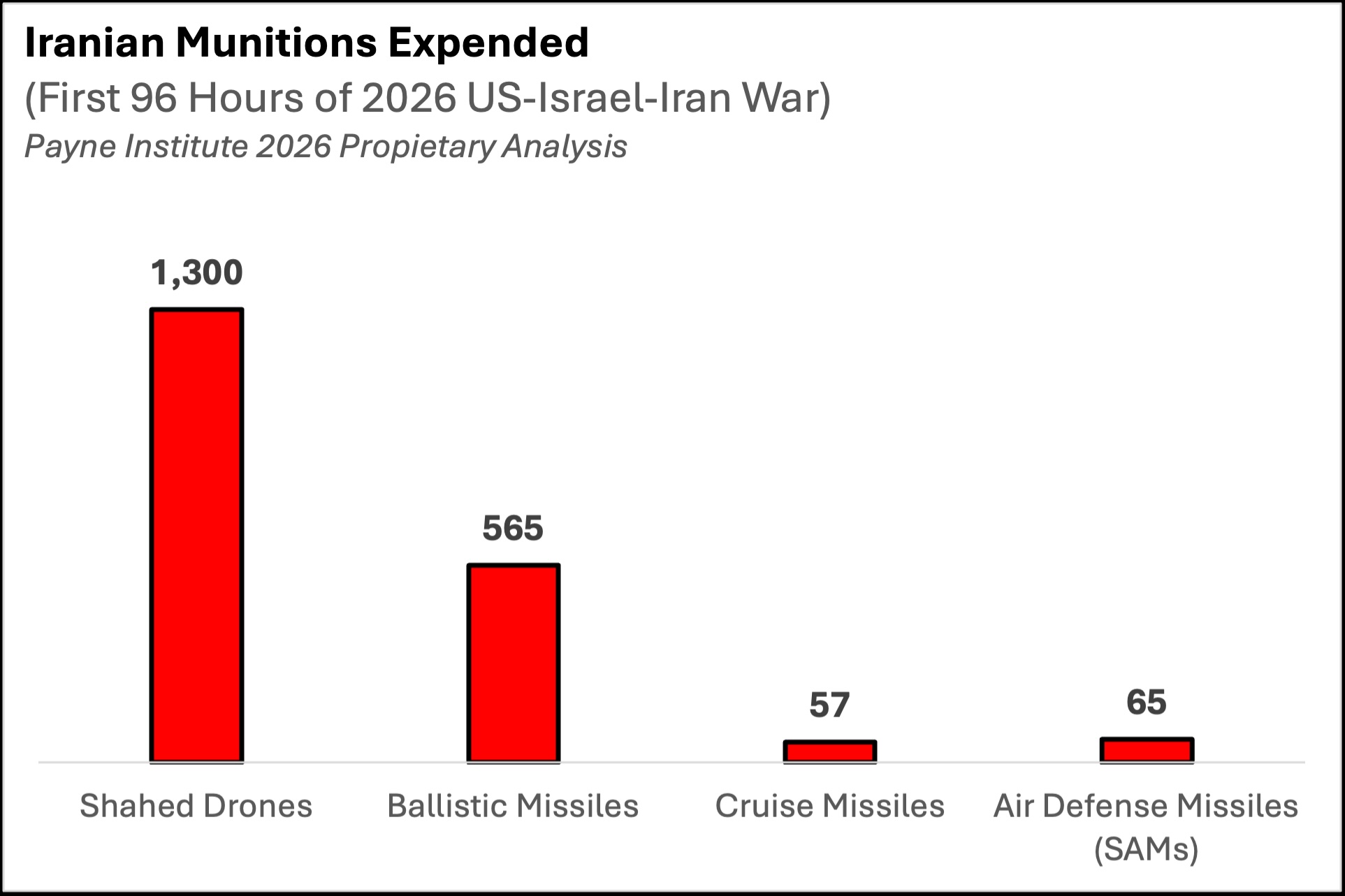
“The first 96 hours capture the peak stress test, revealing what happens when an adversary attempts to saturate defences before suppression and attrition take hold. deliberate Iranian strategy to overwhelm defences by trading their cheaper, mass-produced munitions for the West’s expensive, finite interceptors,” the authors said. “While access, stealth, and targeting remain critical, the limiting factor in a peer conflict is the ability to keep striking and keep defending after the initial salvos.”
The US has already been forced to start drawing on its ammo and equipment in the Indo-Pacific regions to restock and reequip its forces in the Middle East.
“This shift in assets demonstrates that the American defence industrial base cannot comfortably support a two-theatre posture,” the authors said. “The ability to replenish magazines is not a switch that can be flipped with emergency appropriations or executive orders—it is a long chain that starts with access to minerals, energetics, and sub-tier suppliers and ends in certified production lines that do not surge on command.”
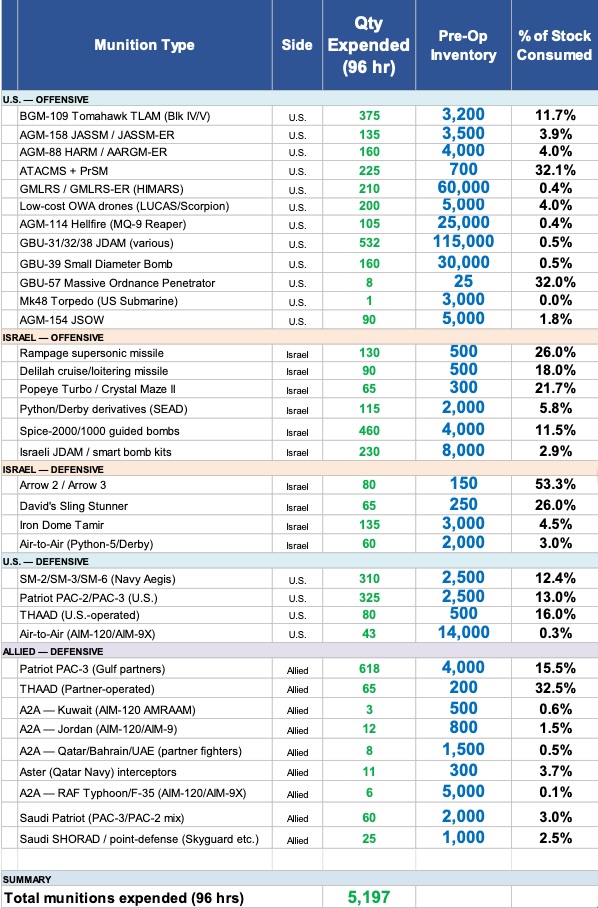
Stocks running low of the best ammo
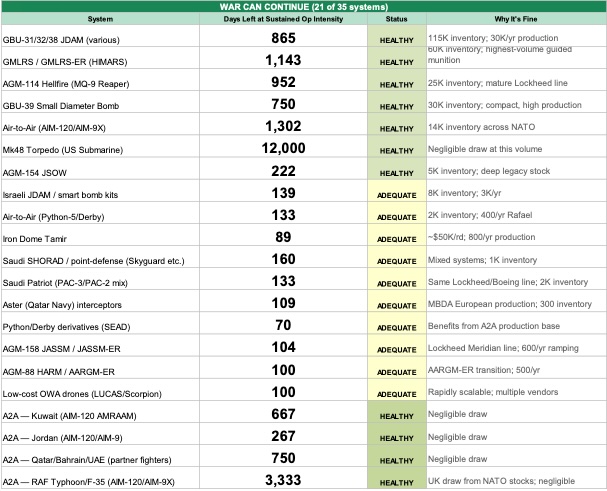
While the US remains well supplied with much of its workhorse munitions, it is starting to run low on some systems, and according to FPRI, those are the very munitions that are hardest to replace.
“Of the 35 munition types we tracked, 21 remain in a healthy condition, with deep inventories and mature production lines. But the war’s true bill is concentrated in the 14 systems now critically strained—they are disproportionately the systems that make modern air defence credible and long-range strike meaningful,” the authors said.
Amongst the problematic systems are:
The Iranians have planned and prepared well for the unfolding asymmetrical war. The US has already expended much of its surplus to Ukraine under the Biden administration. Now it is expending even more in the Iranian theatre and depleting its strength in the Indo-Pacific at the same time.
“America’s readiness for a larger, second-theatre contingency quietly bleeds out with every high-end munition fired. It also gives Chinese leaders a reason to do the “missile math” when it comes to considering how their military might fare in a conflict over Taiwan,” say the authors.
The defensive interceptor arithmetic is the most worrying. America’s Gulf partners have invested heavily in US arms and their Patriot batteries combined fired 943 rounds in 96 hours, consuming 18 months of production from a single shared Lockheed Martin/Boeing production line currently running at 620 interceptors per year.
Even with Poland’s WZL-1 facility now contributing PAC-3 MSE launch tubes to the global supply chain, the binding constraint remains the Boeing seeker assembly, which limits final production regardless of how many other components are available.
Likewise, the US’ legendary Tomahawk missiles are now only 34 days away from being exhausted. Currently the US only produces 85 units per year, so replacing the operation expenditure of 375 missiles in 96 hours would take 53 months to replace.
These delays are likely to cause political problems for the US as well. Gulf partners fired nearly double the number of Patriot interceptors as US forces, absorbing the heaviest defensive burden. Yet, under the Foreign Military Sales (FMS) process, their replenishment orders placed behind the US in the production queue. That adds an additional six to a year of delays to their reload timelines in an order book that is already full to bursting.
“This industrial reality has profound implications for alliance credibility and the true foundation of American security guarantees. Decades of a shrinking defence industrial base means a shrinking, aging workforce that cannot be surged by presidential decree, adding another critical layer to the “Command of the Reload” problem.”
Mineral and production bottlenecks
“Policymakers consistently overlook a fundamental reality of modern war: You do not replenish missiles solely with money. They are replenished via chemistry, machine time, and processed inputs, each with their own chokepoints,” say the authors.
Replacing the 5,197 munitions fired in the first three days of fighting will require approximately 92 tonnes of copper, 137 kilograms of neodymium, 18 kilograms of gallium, 37 kilograms of tantalum, 7 kilograms of dysprosium, and 600 tonnes of the rocket fuel ammonium perchlorate. The rare earths and specialty metals are small by weight but are absolutely essential and virtually all come from China.
China controls 98% of global gallium production (banning exports to the United States in December 2024), 90% of neodymium processing, and 99% of dysprosium, FRPI reports.
“These rare earths and specialty metals are inside every seeker head, guidance system, and radar module in the coalition’s inventory. They cannot be substituted at scale, and alternative supply chains are years away from delivering meaningful volume,” the authors said.
A separate problem is that underinvestment in the last decade as the US pivoted from arming to fight a large-scale war, to the “war on terror” under the late Secretary of Defence Donald Rumsfeld, where it prepared to fight terrorist groups and insurgencies not large armies. Iran has a population of 90mn people, with a standing army of some 600,000 men, including just under 200,000 in the fanatical IRGC guard. This week US President Donald Trump deployed a Marine force of 5,000 men from Okinawa which will arrive in the Gulf at the end of this month.
“Ammonium perchlorate is the biggest vulnerability. It is the solid rocket oxidizer present in every missile with a solid motor, from Patriot to THAAD to Arrow to ATACMS. The 600 tonnes required to reload one 96-hour operation represents 6.7% of the entire annual production capacity of AMPAC’s facility in Cedar City, Utah, the single domestic source,” say the authors.
There is also a lack of explosive production capacity. All of America’s high explosives are made by a single factory, the Holston Army Ammunition Plant in Kingsport, Tennessee, operated by BAE Systems. After WWII it had ten production lines. Now it has two.
The lack of the explosive production capacity is the tip of a broader structural vulnerability iceberg within the US defence industrial base. In a 2023 review of the munitions supply chain, the US Army identified more than 100 single points of failure across production networks tied to explosives and related materials.
The reliance on a single domestic supplier also contrasts with developments in China, which has been mass-producing newer generations of military explosives since 2011, according to the report.
But the most devastating blow struck Iran that highlights its cost-to-kill advantage, as it appears to have destroyed all four of the US’ billion-dollar THAAD radar systems in the Middle East.
“The radars destroyed by Iran are orders of magnitude more mineral-intensive than the munitions they were designed to direct. A single AN/FPS-132 radar contains approximately 75 kilograms of gallium in its phased-array transmit/receive modules, more than four times the gallium needed to replace all 5,197 munitions fired in the first four days of the operation,” the authors wrote.
The US has no hope of replacing this system and have already started dismantling the four surviving systems deployed in Asia to be shipped to the Middle East. In the meantime, the THAAD air defence missiles, amongst the most sophisticated in the US arsenal, may have been blinded and made useless.
The IntelliNews PRO service includes access to reports, exclusive market data, and more news that decision-makers care about. Stay ahead of the market with IntelliNews PRO.
Sign Up Now


