
_0_1780930643.jpg)


Russia goes on the offensive against Armenian PM Pashinyan
4 days ago
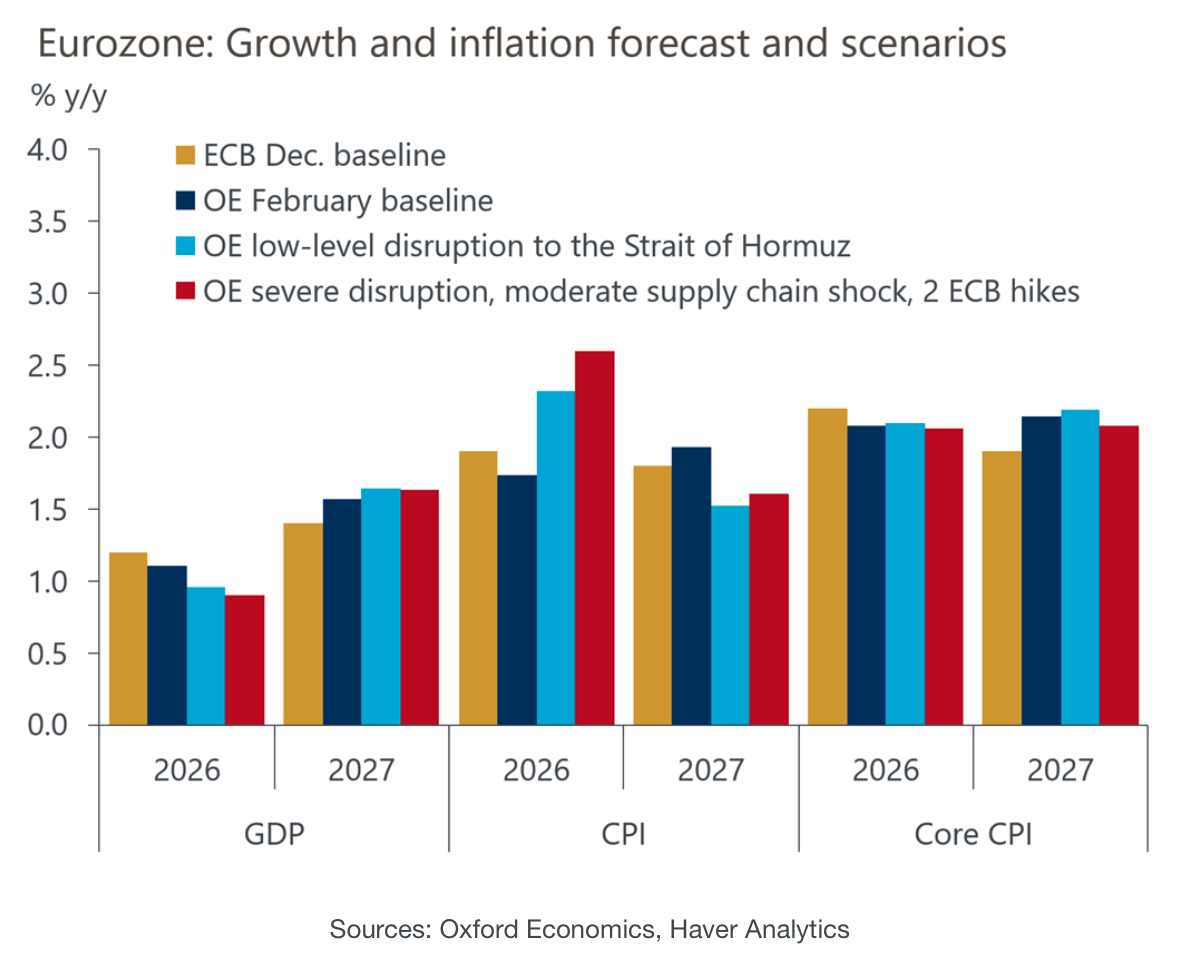
The escalating conflict involving Iran risks delivering a fresh energy shock to the eurozone, potentially lifting inflation while slightly slowing economic growth, according to Nicola Nobile, Chief Italy Economist at Oxford Economics.
“The Iran conflict has introduced a significant energy shock to the Eurozone,” Nobile said in a note emailed to clients, adding that Oxford Economics expects higher energy prices stemming from “a moderate disruption in the Strait of Hormuz”.
As markets opened on March 9, prices of oil surged above $100 per barrel for the first time. Under the consultancy’s initial assumptions, Brent crude is expected to average about $79 per barrel in the second quarter, roughly $15 above its February baseline forecast, before easing as supply disruptions subside later in the quarter.
Gas markets are also expected to tighten as Asian buyers compete more aggressively with Europe for limited supplies of LNG after Qatar shut down production last week. The price of gas on the Title Transfer Facility (TTF) Virtual Trading Point in the Netherlands has already almost doubled from €35MTh ($10.25/MMBtu) at the end of February to €52.8MTh ($15.5/MMBtu) as of the start of trading on March 9.
“We expect the disruption to Qatari liquefied natural gas exports to force Asian buyers to compete aggressively with Europe for cargoes, lifting Dutch TTF to around €45/MWh ($14/MMBtu) – around 30% above our February baseline,” Nobile said.
Higher energy prices would feed directly into consumer prices across the currency bloc. Oxford Economics expects the shock to raise eurozone headline inflation by about 0.5 percentage points in 2026 compared with previous forecasts.
“Our new baseline will be published next Tuesday, but we anticipate it will show around a 0.5ppt increase in headline inflation in 2026, potentially averaging 2.2–2.3% this year, up from 1.7% in our February baseline,” Nobile said.
The impact on economic activity is expected to be more modest. “The impact to Eurozone activity is limited in both cases – around 0.1ppt-0.2ppts for this year's GDP,” she said. Nevertheless, Nobile warned that the eurozone remains more exposed to energy disruptions than other advanced economies.
“Outside the Gulf Cooperation Council countries, Eurozone countries are more exposed to this shock than the US or other advanced economies, such as the UK,” he said, pointing to Europe’s reliance on imported energy and Middle Eastern transport routes.
Persistently high energy prices could also complicate monetary policy for the European Central Bank. “Another adverse shock to inflation will be a headache for the European Central Bank,” Nobile said. While policymakers may initially treat a temporary spike in inflation as transitory, he added that “the ECB may opt for one to two rate hikes if the conflict looks likely to be protracted and the impact more severe.”
Recent economic data had already shown renewed price pressures in the bloc. Eurozone inflation rose to 1.9% year-on-year in February, with core inflation at 2.4% and services inflation reaching 3.4%, driven in part by strong readings in France and Italy.
Alongside geopolitical risks, European policymakers are attempting to strengthen industrial resilience. The European Commission recently unveiled its Industrial Accelerator Act, aimed at promoting domestic manufacturing and decarbonisation through procurement rules and subsidies favouring “Made in EU” production.
However, Nobile questioned how quickly such policies could reshape supply chains. “Firms respond primarily to economic incentives, not political announcements,” he said. “The key question, if the Act is adopted, is whether these incentives will be strong enough to shift production locations in a meaningful way.”
He added that structural barriers remain significant. “Inertia in these decisions is important, due to the high fixed costs associated with setting up in other countries and establishing stable commercial relationships,” Nobile said, noting that “despite talk of de-risking, there hasn't been a reduction in EU supply-chain vulnerabilities.”
The IntelliNews PRO service includes access to reports, exclusive market data, and more news that decision-makers care about. Stay ahead of the market with IntelliNews PRO.
Sign Up Now

_0_1780326589.jpg)

