


Russian services downturn deepens as demand weakens and confidence hits three-and-a-half-year low
1 hour ago
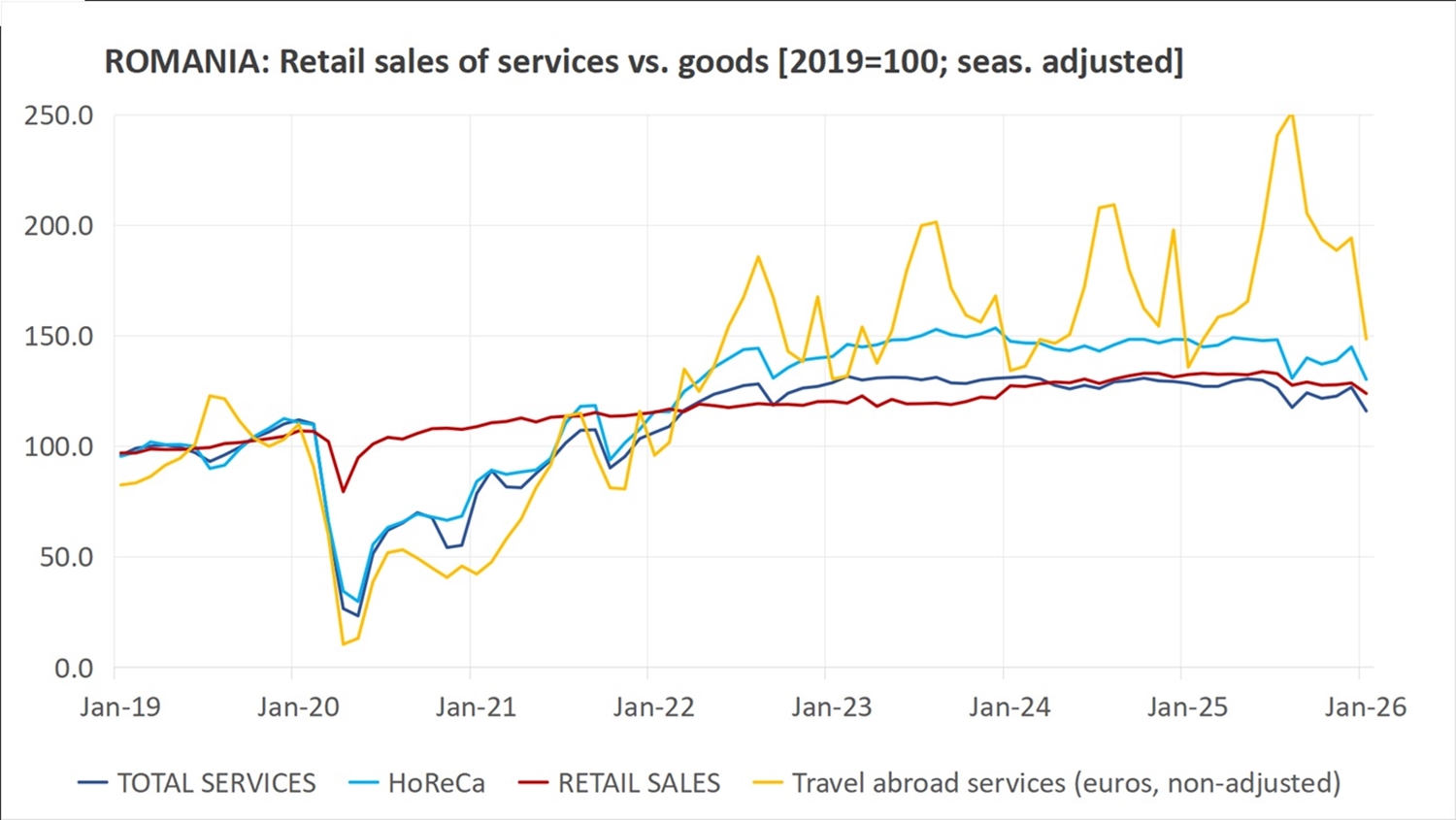
The consumption of services by Romanian households (chart) dropped sharply at the start of 2026, with the turnover volume index of companies providing services to households declining by 13.1% y/y in January, according to data published by the national statistics office (INS). On a monthly basis, the indicator plunged by 8.5% m/m (seasonally and workday adjusted), pointing to a sudden deterioration in demand.
The contraction reflects a growing propensity to save among households amid rising uncertainty, a trend also visible in retail trade. Retail sales volume fell by 9.1% y/y and 3.7% m/m in January, confirming a broader pullback in consumption.
The decline in services consumption comes after a period of relative stability throughout 2023–2024 and the first half of 2025. However, the trend started to reverse in mid-2025, when services demand dropped by 7.0% m/m in August following increases in VAT rates and persistent inflation, which eroded real incomes. At that time, the standard VAT rate was raised from 19% to 21%, while the reduced rate for HoReCa more than doubled from 5% to 11%.
The HoReCa sector has been particularly affected. In January, turnover in hotels, restaurants and cafés contracted by 15.8% y/y and 10.1% m/m, a steeper decline than the overall services sector. Part of this drop is explained by base effects, as HoReCa had previously experienced strong growth supported by government stimulus schemes during 2022–2023. By 2024 and early 2025, consumption of HoReCa services remained 40–50% above 2019 levels, compared to retail sales, which were only about 30% higher than pre-pandemic levels.
Despite rising household incomes in 2024, spending patterns shifted that year. While sales of discretionary non-food goods surged by 23% y/y, consumption of HoReCa services declined by 1.5% y/y. At the same time, spending on travel services abroad — as reported by the National Bank of Romania (BNR) — increased modestly by 3% y/y in 2024 (in euro terms), indicating a reallocation rather than an overall surge in services consumption (in contrast to surging private consumption).
This substitution trend (consumption of foreign versus local HoReCa services) became more pronounced in 2025. Spending on travel abroad surged during the summer months (July–August), in contrast to the shrinking domestic HoReCa activity. The pattern persisted into 2026: in January, expenditure on travel services abroad increased by 11.5% y/y, in stark contrast to the sharp contraction in domestic services consumption, particularly in HoReCa.
The IntelliNews PRO service includes access to reports, exclusive market data, and more news that decision-makers care about. Stay ahead of the market with IntelliNews PRO.
Sign Up Now


